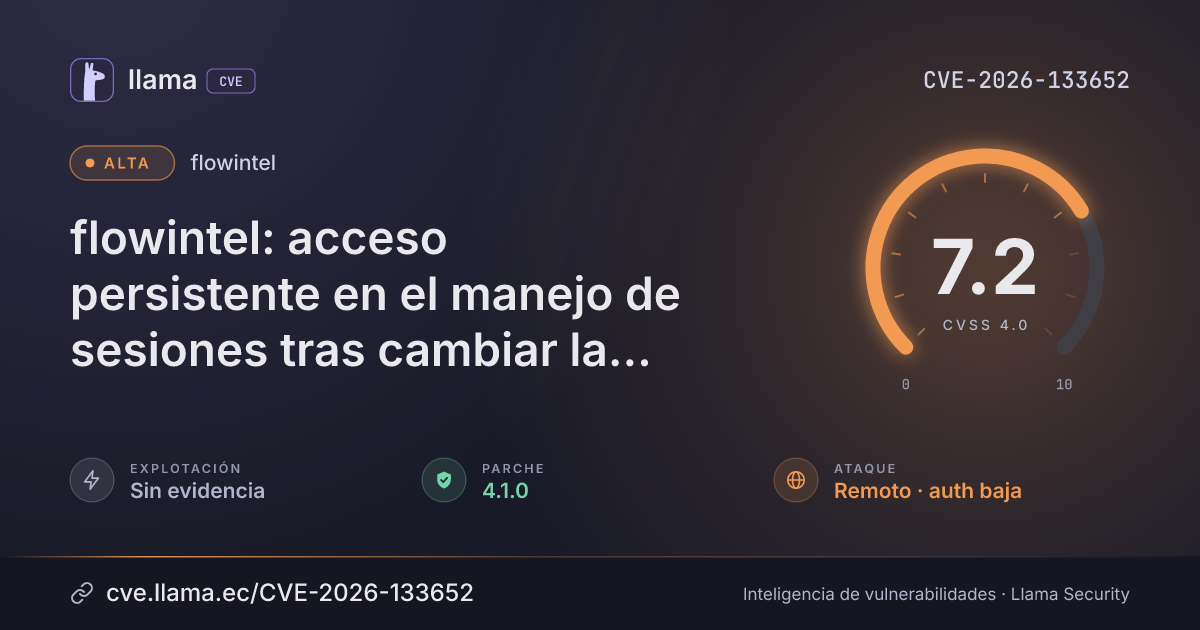
CVE-2026-133652
flowintel persistent access in session handling after password change
Low-privilege attackers can keep access after a password change and alter email or password without the current one.
CVSS:4.0/AV:N/AC:L/AT:N/PR:L/UI:N/VC:L/VI:H/VA:H/SC:N/SI:N/SA:N
Fuente: CNA
Ciclo de vida de la vulnerabilidad
| Fecha | Fase | Evento | Detalle |
|---|---|---|---|
| Divulgación | Publicada | CVE-2026-133652 divulgada · CVSS 7.2 (CNA) | |
| Monitoreo | Detectada | Ingresó al índice | |
| Monitoreo | Fuente: NIST NVD | Registro visto por primera vez en NIST NVD | |
| Divulgación | Evaluación SSVC | CISA-ADP · explotación ninguna | |
| Divulgación | Modificada | Última actualización del registro | |
| Monitoreo | Fuente: ENISA EUVD | Registro visto por primera vez en ENISA EUVD | |
| Monitoreo | Verificada | Última verificación contra las fuentes |
Flowintel contains a session management flaw in its browser login handling, where session identifiers are based on a bare numeric user ID rather than a credential-bound token. A remote attacker who has low-privilege access to an account (such as an active session or a remember-me cookie) can keep access after the password changes, or change the account's email address or password without knowing the current password.
Descripción original del registro (CIRCL)
Flowintel , contained a session management vulnerability in its browser authentication mechanism. The session identifier used a bare numeric user ID rather than a credential-bound token, resulting in several related weaknesses: - Remembered logins (remember-me cookies) remained valid after a user changed their password, allowing an attacker holding a previously issued cookie to retain access indefinitely. - Server-side session identifiers were not rotated upon login (local, SSO, or remembered), enabling session fixation. - Self-service email and password changes did not require verification of the current password, permitting an attacker with an active session to modify account credentials without knowledge of the existing password. - Administrator-initiated password resets did not revoke other browser sessions, invalidate remembered logins, or rotate the affected user's API key. An attacker who obtained a valid session or remember-me cookie (e.g., through XSS, network interception, or cookie theft) could maintain unauthorized access even after the legitimate user changed their password. Additionally, an attacker with any valid session could change the account's email address or password without knowing the current credentials, effectively taking over the account. Affected versions: Flowintel prior to 4.1.0.
Desglose de métricas
Rangos afectados
Estado del parche por paquete
| Paquete / producto | Estado | Corregida en | Desde divulgación | Última versión |
|---|---|---|---|---|
flowintel |
Corregida | 4.1.0 | — | — |
4.1.0Arsenal público
Sin exploits, módulos ni PoC públicos conocidos a la fecha de verificación.
https://github.com/flowintel/flowintel/commit/a7f025ecfdf60dc0ea3438c79b21a8edc2449836Las referencias externas se muestran para copiar: cve.llama.ec no lo redirige a otros sitios.