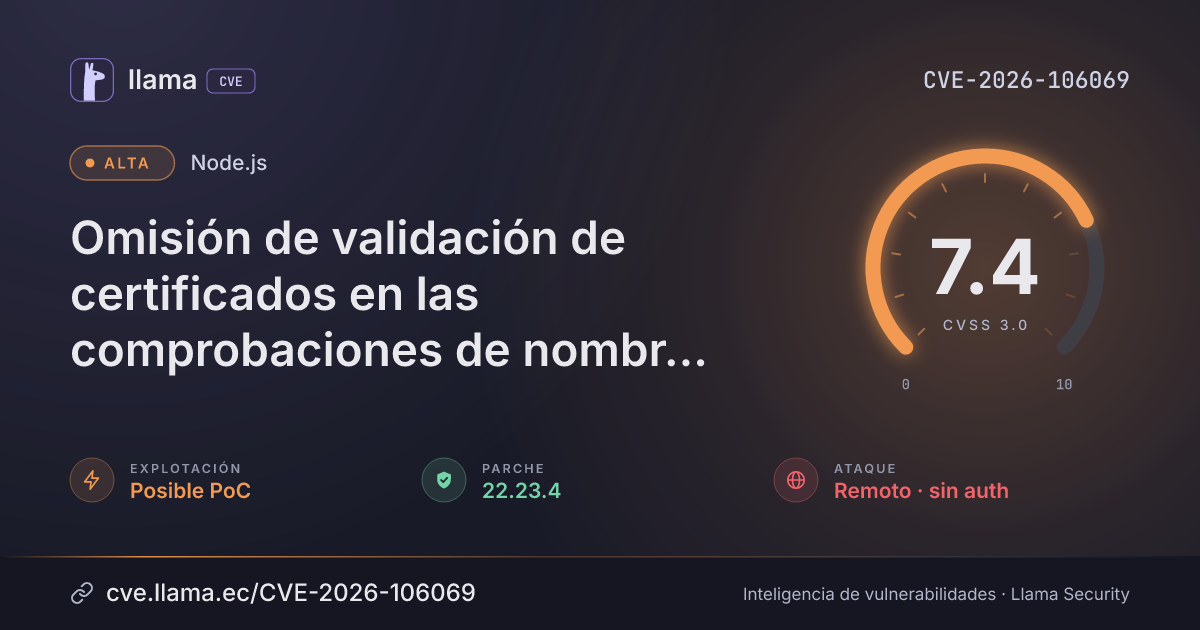
CVE-2026-106069
Node.js certificate validation bypass in TLS hostname checks
A malicious server could impersonate a trusted host by presenting a certificate issued for a different IP address.
CVSS:3.0/AV:N/AC:H/PR:N/UI:N/S:U/C:H/I:H/A:N
Fuente: CNA
Ciclo de vida de la vulnerabilidad
| Fecha | Fase | Evento | Detalle |
|---|---|---|---|
| Divulgación | Publicada | CVE-2026-106069 divulgada · CVSS 7.4 (CNA) | |
| Monitoreo | Detectada | Ingresó al índice | |
| Monitoreo | Fuente: NIST NVD | Registro visto por primera vez en NIST NVD | |
| Monitoreo | Fuente: ENISA EUVD | Registro visto por primera vez en ENISA EUVD | |
| Divulgación | Evaluación SSVC | CISA-ADP · explotación ninguna | |
| Divulgación | Modificada | Última actualización del registro | |
| Monitoreo | Fuente: PoC-in-GitHub | Registro visto por primera vez en PoC-in-GitHub | |
| Monitoreo | Verificada | Última verificación contra las fuentes |
The vulnerability affects Node.js versions 22.x, 24.x, and 26.x, specifically its TLS hostname verification used when clients connect to servers using non-canonical IPv4 addresses with leading zeros. This can allow a client to accept a server certificate issued for a different IP address than the one it actually connected to, potentially enabling a malicious server to impersonate another trusted host.
Affects Node.js 22.23.3, 24.22.0 and 26.12.0 when connecting to IPv4 hosts written with a leading zero octet on platforms like macOS. Fixed in Node.js 22.23.4.
Descripción original del registro (hackerone)
A flaw in Node.js TLS hostname verification can cause a server certificate to be validated against a different IP address than the one the client connected to, when the host is a non-canonical IPv4 literal with a leading zero, such as `0127.0.0.1`. `tls.checkServerIdentity()` normalizes the host following the WHATWG URL rules, which read a leading-zero octet as octal (`0127.0.0.1` becomes `87.0.0.1`), while the connection is made through the operating system resolver, which on some platforms such as macOS reads it as decimal (`127.0.0.1`). A server at the connected address can then be authenticated with a certificate issued for another IP address. This vulnerability affects Node.js **26.x**, **24.x**, and **22.x**.
Condiciones y alcance
Desglose de métricas
Rangos afectados
Estado del parche por paquete
| Paquete / producto | Estado | Corregida en | Desde divulgación | Última versión |
|---|---|---|---|---|
node |
Corregida | 22.23.4 | — | — |
22.23.4Arsenal público
Ver los 1 repositorios de GitHub
Los repositorios públicos incluyen exploits, escáneres, laboratorios y reglas de detección. No ejecute código de terceros sin revisarlo en un entorno aislado.
https://nodejs.org/en/blog/vulnerability/october-2026-security-releaseshttps://github.com/CompleteTech-Security/node-cve-2026-106069-checkLas referencias externas se muestran para copiar: cve.llama.ec no lo redirige a otros sitios.