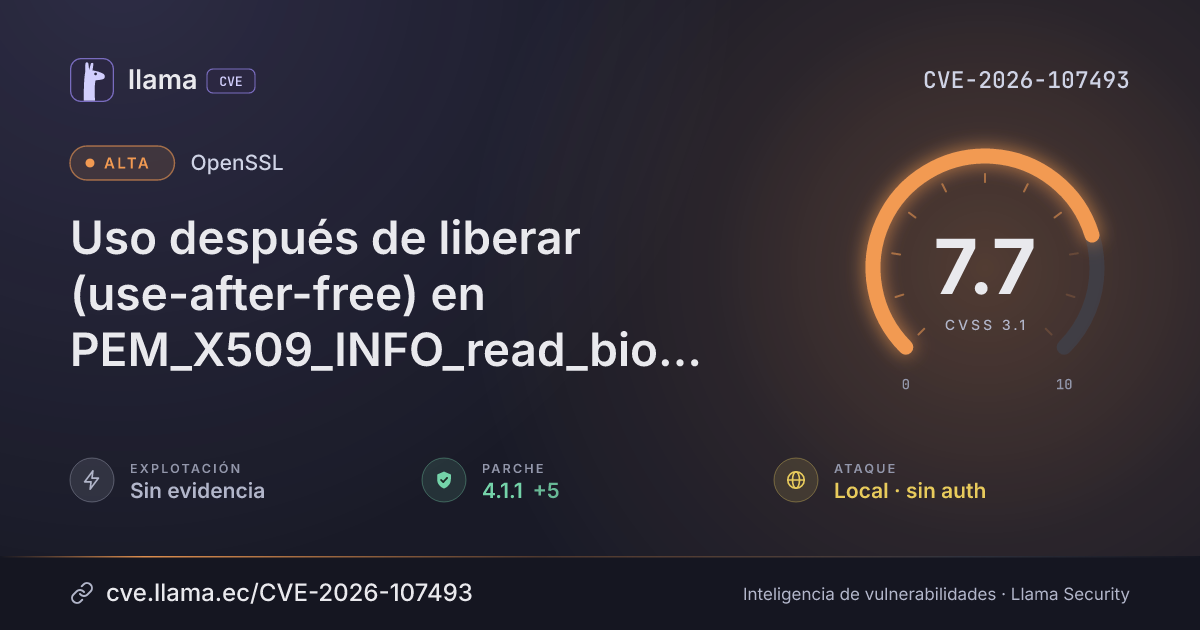
CVE-2026-107493
OpenSSL use-after-free in PEM_X509_INFO_read_bio_ex()
An attacker can send malformed PEM data that makes an application reusing a stack crash or possibly corrupt memory.
CVSS:3.1/AV:L/AC:L/PR:N/UI:N/S:U/C:H/I:N/A:H
Fuente: CISA-ADP
Ciclo de vida de la vulnerabilidad
| Fecha | Fase | Evento | Detalle |
|---|---|---|---|
| Divulgación | Publicada | CVE-2026-107493 divulgada · CVSS 7.7 (CISA-ADP) | |
| Monitoreo | Detectada | Ingresó al índice | |
| Monitoreo | Fuente: NIST NVD | Registro visto por primera vez en NIST NVD | |
| Monitoreo | Fuente: ENISA EUVD | Registro visto por primera vez en ENISA EUVD | |
| Divulgación | Evaluación SSVC | CISA-ADP · explotación ninguna | |
| Divulgación | Modificada | Última actualización del registro | |
| Monitoreo | Verificada | Última verificación contra las fuentes |
In OpenSSL, a failed read in PEM_X509_INFO_read_bio_ex() frees the stack entries, including ones the application passed in, but leaves dangling pointers in the stack. Applications that pass an existing stack and keep using it after a failed read can crash or, in principle, corrupt memory, and malformed PEM data can trigger the failure.
Only applications that pass a non-NULL existing X509_INFO stack to PEM_X509_INFO_read_bio_ex() are affected. The fixed version named for this bug is OpenSSL 4.1.1.
Descripción original del registro (openssl)
Issue summary: When an application passes a stack to PEM_X509_INFO_read_bio_ex() to add entries to, and reading fails, OpenSSL frees every entry in the stack, both the old ones and any new ones, but leaves them in the stack. Impact summary: An application that passes an existing stack to PEM_X509_INFO_read_bio_ex() and keeps using it after a failed read may use memory that was already freed. This can cause a crash or, in principle, memory corruption. Malformed PEM data can make the read fail, but only applications that pass an existing stack are affected, and OpenSSL itself does not do this. CWE: CWE-416: Use After Free Description: PEM_X509_INFO_read_bio_ex() reads certificates, CRLs and private keys from PEM data and adds them to a stack of X509_INFO structures. If the application passes a stack that is not NULL, the function adds the new entries to it and must leave the entries that are already there unchanged. If reading fails, the function frees every entry in the stack. This includes the entries that were there before the call, and the entries added by the call. It does not remove these entries from the stack, so the stack keeps pointers to freed memory. The failure can happen at any point, even before any entry was added. A PEM item with invalid content is enough. This also happens if the stack was empty: entries added before the failure are freed but stay in the stack. An application that then reads or frees the stack will use memory that was already freed. This can crash the application or, in principle, corrupt memory. Only applications that pass a stack that is not NULL are affected. OpenSSL itself never does this. Its own callers, including the code that TLS uses to load CA certificates, always pass NULL. When the stack is NULL, the function frees only the entries that it created itself, which is safe. We expect that very few applications pass an existing stack. An attacker can make the read fail with malformed PEM data, but cannot make an application pass an existing stack. The same problem affects PEM_X509_INFO_read_bio(), PEM_X509_INFO_read() and PEM_X509_INFO_read_ex(), which use the same code. OpenSSL 1.1.1 and 1.0.2 have only the first two of these functions. FIPS impact: no The affected code is outside the FIPS module boundary.
Condiciones y alcance
Desglose de métricas
Rangos afectados
Estado del parche por paquete
| Paquete / producto | Estado | Corregida en | Desde divulgación | Última versión |
|---|---|---|---|---|
OpenSSL |
Corregida | 1.0.2zt, 1.1.1zk, 3.0.24, 3.5.10, 4.0.4, 4.1.1 | — | — |
1.0.2zt1.1.1zk3.0.243.5.104.0.44.1.1Arsenal público
Sin exploits, módulos ni PoC públicos conocidos a la fecha de verificación.
https://openssl-library.org/news/secadv/20261117.txthttps://github.com/openssl/openssl/commit/c57a5ccf0c060755b5494a6870922b7c6cdd7dd8https://github.com/openssl/openssl/commit/0486dfadfec558e1808f59d35a8d79e541c4e7d7https://github.com/openssl/openssl/commit/c8f6d04f8e6d40b1bf83334e4a2ec9daf5943a3dLas referencias externas se muestran para copiar: cve.llama.ec no lo redirige a otros sitios.