llamaCVEVulnerability Intelligence
/
OTP

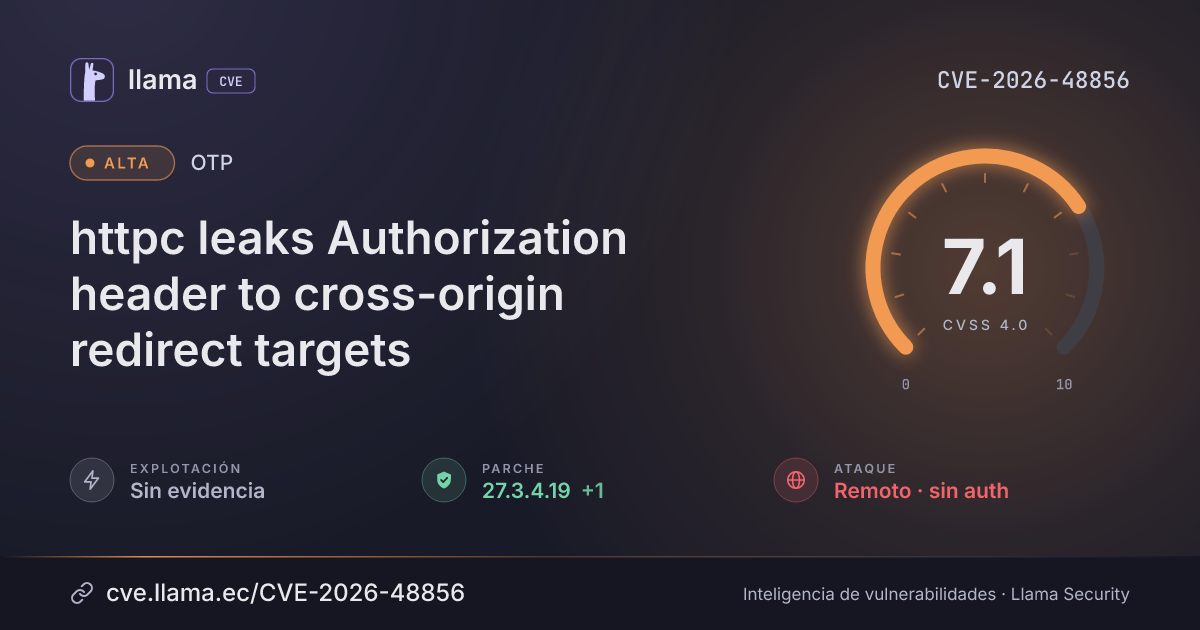
CVE-2026-48856

httpc leaks Authorization header to cross-origin redirect targets

Specific setups onlyParche disponibleopen redirect
Descargar PNG JSON
CVSS 4.0
7.1
Alta
CVSS:4.0/AV:N/AC:L/AT:N/PR:N/UI:P/VC:H/VI:N/VA:N/SC:N/SI:N/SA:N Fuente: CNA
6.5NVD · CVSS 3.1CVSS:3.1/AV:N/AC:L/PR:L/UI:N/S:U/C:H/I:N/A:N
ExplotaciónSin evidenciaSSVC: none · no figura en CISA KEV
Exploits públicos0Ninguno conocido
Parche2 versiones9.3.2.8 · 27.3.4.19
Exposición162 dDesde la divulgación, 10 jun 2026, 9:41 a. m.
Detección134 dDesde la divulgación hasta su ingreso al índice
Decisión SSVCSeguir
Remediar en la ventana regular de mantenimiento
Sin explotación conocida, no automatizable e impacto técnico parcial. Hay versiones corregidas disponibles.
Timeline

Ciclo de vida de la vulnerabilidad

Hoy
Divulgación
Publicada +1
Modificada
Explotación
Remediación
Monitoreo
Detectada
Fuente: OSV
Verificada
10 jun 26
22 oct 26
24 oct 26
19 nov 26
20 nov 26
10 jun 26
21 jul 26
30 ago 26
10 oct 26
20 nov 26
FechaFaseEventoDetalle
Divulgación Publicada CVE-2026-48856 divulgada · CVSS 7.1 (CNA)
Divulgación Evaluación SSVC CISA-ADP · explotación ninguna
Monitoreo Detectada Ingresó al índice
Monitoreo Fuente: OSV Registro visto por primera vez en OSV
Divulgación Modificada Última actualización del registro
Monitoreo Verificada Última verificación contra las fuentes
Resumen

Sensitive Data Exposure vulnerability in Erlang OTP inets (httpc_response module) allows Retrieve Embedded Sensitive Data. The httpc client forwards the Authorization and Proxy-Authorization request headers to redirect targets without checking whether the redirect crosses an origin boundary. httpc_response:redirect/2 constructs the redirected request by updating only the host field of the header record; all other fields (including authorization and proxy_authorization) are copied verbatim. The redirect target host is never compared against the original host. autoredirect defaults to true, so this affects all httpc callers that do not explicitly disable automatic redirects. An attacker who controls a server that the victim contacts via httpc can issue a cross-origin 3xx redirect to a server they also control. The Authorization header (including Basic credentials derived from URL userinfo via httpc_request:handle_user_info/2) is forwarded to the redirect target, allowing credential theft. The same applies to the Proxy-Authorization header. This vulnerability is associated with program files lib/inets/src/http_client/httpc_response.erl. This issue affects OTP from OTP 17.0 before OTP 27.3.4.19, OTP 28.5.0.8, and OTP 29.1.2, corresponding to inets from 5.10 before 9.3.2.8, 9.6.2.4, and 9.8.1. Whether OTP before OTP 17.0, corresponding to inets before 5.10, is affected is unknown.

¿Qué significa?httpc can send the Authorization and Proxy-Authorization headers, including Basic credentials taken from URL userinfo, to a different origin reached through a redirect. An attacker-controlled server reached by such a redirect can receive those credentials.
¿Quién está afectado?The issue affects OTP from 17.0 before 27.3.4.19, 28.5.0.8, and 29.1.2, and inets from 5.10 before 9.3.2.8, 9.6.2.4, and 9.8.1. It matters for httpc callers that leave automatic redirects enabled, which is the default (autoredirect true). To check, compare the installed OTP release and inets version with those ranges, and look for autoredirect being set to false in httpc:request/4 options.
Contexto

Condiciones y alcance

Condiciones necesarias para que el fallo sea explotable
01
Erlang/OTP versions from 17.0 before 27.3.4.19, 28.5.0.8, and 29.1.2 (inets from 5.10 before 9.3.2.8, 9.6.2.4, and 9.8.1).“This issue affects OTP from OTP 17.0 before OTP 27.3.4.19, OTP 28.5.0.8, and OTP 29.1.2”
02
httpc automatic redirects left enabled (autoredirect defaults to true).“so this affects all httpc callers that do not explicitly disable automatic redirects”
¿Quién debe revisar?Teams running Erlang/OTP httpc (inets) before OTP 27.3.4.19, 28.5.0.8 or 29.1.2 that make requests with automatic redirects enabled, including those putting credentials in URL userinfo.
MitigaciónSet {autoredirect, false} in the httpc:request/4 options and handle redirects manually, stripping the Authorization header when the redirect crosses an origin boundary.
Vector CVSS 3.1

Desglose de métricas

Opción resaltada = valor del vector · izquierda = peor caso · NVD
Vector de ataqueAV:N
RedAdyacenteLocalFísica
ComplejidadAC:L
BajaAlta
PrivilegiosPR:L
NingunoBajosAltos
InteracciónUI:N
NingunaRequerida
AlcanceS:U
CambiadoSin cambio
ConfidencialidadC:H
AltoBajoNinguno
IntegridadI:N
AltoBajoNinguno
DisponibilidadA:N
AltoBajoNinguno
Versiones

Rangos afectados

Afectada Corregida
inets≥ 5.10 < 9.3.2.8
otp≥ 17.0 < 27.3.4.19
5.10
9.3.2.8
17.0
27.3.4.19
Remediación

Estado del parche por paquete

Paquete / productoEstadoCorregida enDesde divulgaciónÚltima versión
OTP
Corregida 9.3.2.8, 27.3.4.19 — —
Versiones corregidas9.3.2.827.3.4.19
Explotación

Arsenal público

Sin exploits, módulos ni PoC públicos conocidos a la fecha de verificación.

Registro
EscenarioGENERALEEF
Mitigación* Set {autoredirect, false} in the httpc:request/4 options and handle redirects manually, stripping the Authorization header when the redirect crosses an origin boundary. * Ensure that httpc is only used to contact trusted servers that will not issue cross-origin redirects.EEF
Referencias
Fabricantehttps://github.com/erlang/otp/security/advisories/GHSA-m75x-4vwg-ggjh
Fabricantehttps://www.erlang.org/doc/system/versions.html#order-of-versions
Parchehttps://github.com/erlang/otp/commit/f78fae9294886f95545a2212671282eda230def1
Otrahttps://cna.erlef.org/cves/CVE-2026-48856.html
Otrahttps://osv.dev/vulnerability/EEF-CVE-2026-48856

Las referencias externas se muestran para copiar: cve.llama.ec no lo redirige a otros sitios.