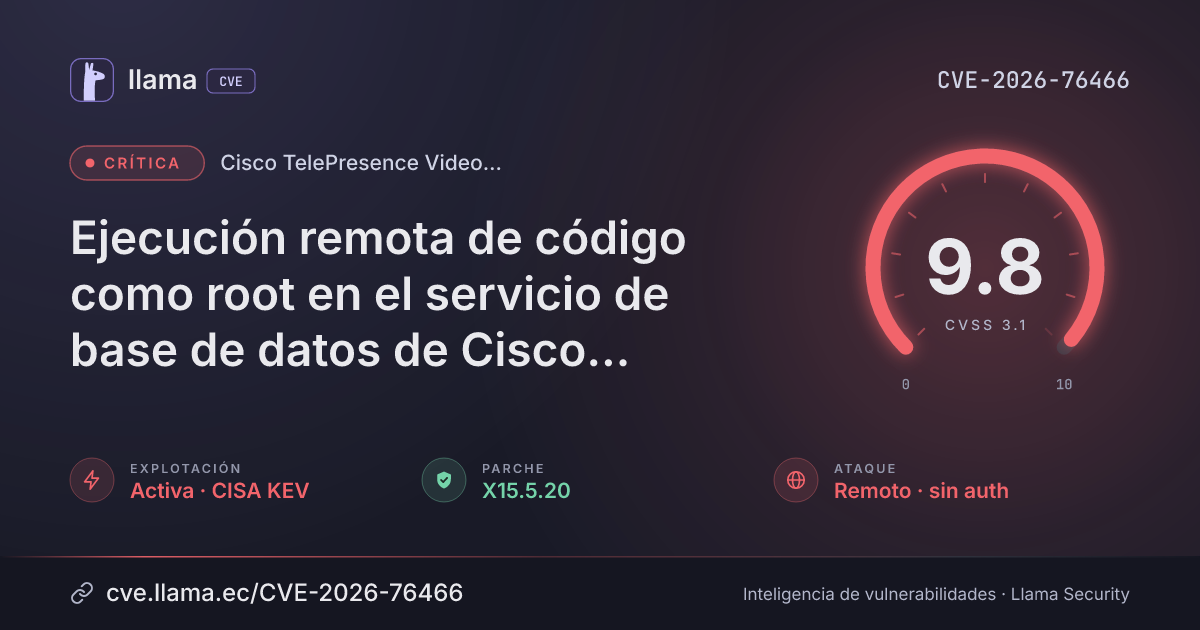
CVE-2026-76466
Cisco TelePresence Video Communication Server (VCS) Expressway remote code execution as root in database service
An unauthenticated attacker on the network can run commands as root on the device by using persistent cookies.
CVSS:3.1/AV:N/AC:L/PR:N/UI:N/S:U/C:H/I:H/A:H
Fuente: CNA
Ciclo de vida de la vulnerabilidad
| Fecha | Fase | Evento | Detalle |
|---|---|---|---|
| Divulgación | Evaluación SSVC | CISA-ADP · explotación activa | |
| Divulgación | Publicada | CVE-2026-76466 divulgada · CVSS 9.8 (CNA) | |
| Monitoreo | Detectada | Ingresó al índice | |
| Monitoreo | Fuente: NIST NVD | Registro visto por primera vez en NIST NVD | |
| Monitoreo | Fuente: ENISA EUVD | Registro visto por primera vez en ENISA EUVD | |
| Monitoreo | Fuente: PoC-in-GitHub | Registro visto por primera vez en PoC-in-GitHub | |
| Explotación | CISA KEV | Agregada al catálogo de vulnerabilidades explotadas | |
| Divulgación | Modificada | Última actualización del registro | |
| Monitoreo | Verificada | Última verificación contra las fuentes | |
| Remediación | Plazo KEV | Fecha límite de remediación para agencias federales (EE. UU.) |
A flaw in the database service of Cisco Expressway Series (the Expressway-C and Expressway-E devices) lets an attacker run operating system commands as root on the underlying system. It can be reached remotely over the network without logging in, and the bug is being exploited in attacks.
Affects Cisco Expressway-C and Expressway-E (virtual or appliance) on vulnerable releases when configured in a cluster, where client certificates are not validated. Fixed in X15.5.20.
Descripción original del registro (cisco)
A vulnerability in the database service feature of Cisco Expressway Series could allow an unauthenticated, remote attacker with network access to a Cisco Expressway device to execute arbitrary operating system commands as root. This vulnerability is due to the use of persistent cookies. Additionally, there is insufficient validation of client certificates when the TLS Verify Mode is set to Enabled for clustering, which means that client certificates are not validated. An attacker with possession of the cookies could exploit this vulnerability by connecting to the database service and invoking specific remote procedure call (RPC) commands. A successful exploit could allow the attacker to execute arbitrary commands as root on the underlying operating system of an affected device. Note: Cisco Expressway Series refers to Cisco Expressway Core (Expressway-C) devices and Cisco Expressway Edge (Expressway-E) devices.
Condiciones y alcance
Desglose de métricas
Versiones afectadas
X8.11.2X8.6X8.11.3X8.2.2X8.8.3X8.11.0X12.5.2X8.1.1X8.9X12.5.1X12.5.6X8.7.3X12.6.0X8.11.1X8.5X8.9.1X8.10.2X8.8.2X8.5.3X8.1X8.9.2X8.11.4X12.5.4X8.8.1X8.2.1X8.5.1X8.6.1X8.1.2X8.8X8.10.0X12.5.3X8.10.1X12.5.7X8.10.3X8.7.1X8.2X12.5.8X8.7X8.5.2X12.5.9X12.5.0X8.10.4X8.7.2X12.5.5X12.6.1X12.6.2X12.6.3X12.6.4X12.7.0X12.7.1X14.0.0X14.0.1X14.0.2X14.0.3X14.0.4X14.0.5X14.0.6X14.0.7X14.0.8X14.2.0Estado del parche por paquete
| Paquete / producto | Estado | Corregida en | Desde divulgación | Última versión |
|---|---|---|---|---|
Cisco TelePresence Video Communication Server (VCS) Expressway |
Corregida | X15.5.20 | — | — |
X15.5.20Arsenal público
Ver los 1 repositorios de GitHub
Los repositorios públicos incluyen exploits, escáneres, laboratorios y reglas de detección. No ejecute código de terceros sin revisarlo en un entorno aislado.
https://sec.cloudapps.cisco.com/security/center/content/CiscoSecurityAdvisory/cisco-sa-vcs-static-cred-hr7EWZ8thttps://www.cisa.gov/known-exploited-vulnerabilities-catalog?field_cve=CVE-2026-76466https://github.com/dinosn/cve-2026-76466https://www.f6.ru/media-center/press-releases/cisco-cve-2026-76466/Las referencias externas se muestran para copiar: cve.llama.ec no lo redirige a otros sitios.