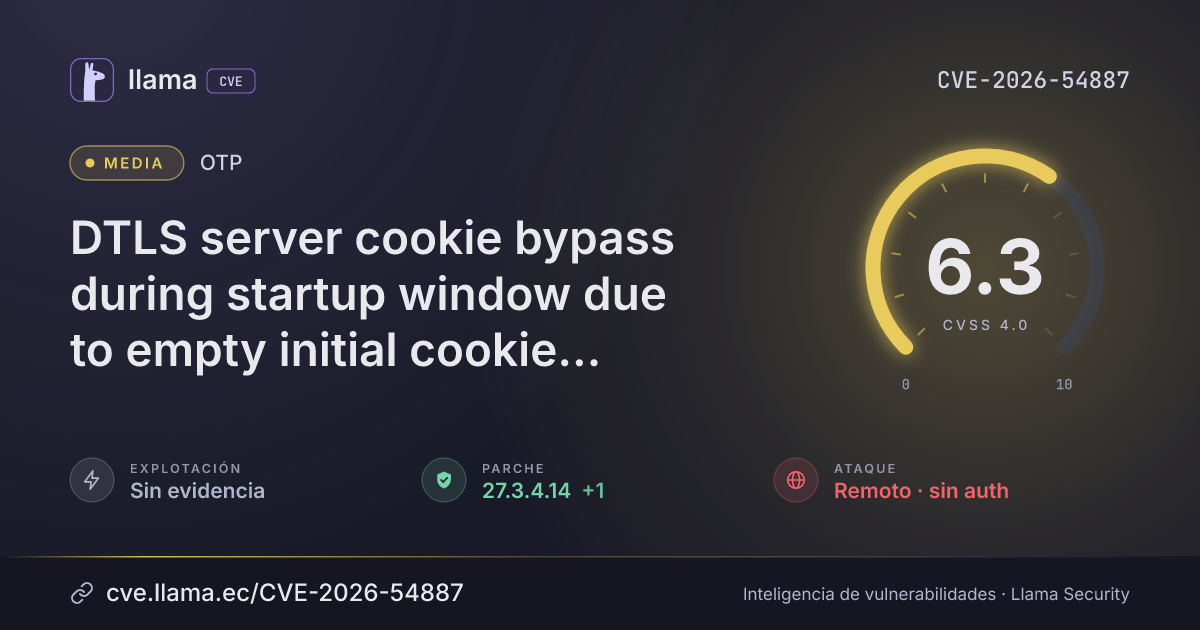
CVE-2026-54887
DTLS server cookie bypass during startup window due to empty initial cookie secret
CVSS:4.0/AV:N/AC:L/AT:P/PR:N/UI:N/VC:N/VI:N/VA:L/SC:N/SI:N/SA:N
Fuente: CNA
Ciclo de vida de la vulnerabilidad
| Fecha | Fase | Evento | Detalle |
|---|---|---|---|
| Divulgación | Publicada | CVE-2026-54887 divulgada · CVSS 6.3 (CNA) | |
| Divulgación | Evaluación SSVC | CISA-ADP · explotación ninguna | |
| Monitoreo | Detectada | Ingresó al índice | |
| Divulgación | Modificada | Última actualización del registro | |
| Monitoreo | Fuente: OSV | Registro visto por primera vez en OSV | |
| Monitoreo | Verificada | Última verificación contra las fuentes |
Use of Default Cryptographic Key vulnerability in Erlang/OTP ssl (DTLS server) allows predictable DTLS cookie computation during the startup window, enabling source address verification bypass. On DTLS server startup, dtls_server_connection:initial_hello/3 initializes previous_cookie_secret to the empty binary (<<>>) instead of a random value. Because HMAC with an empty key is deterministic, anyone who observes the plaintext ClientHello can compute dtls_handshake:cookie(<<>>, IP, Port, Hello) and forge a valid DTLS cookie before the first rotation of the cookie secret. The DTLS cookie (RFC 6347 §4.2.1) is a denial-of-service mitigation that prevents spoofed source IPs from forcing the server to allocate state and perform expensive cryptographic operations; it is not an authentication mechanism. During the window from server startup until the first secret rotation (0 to 15 seconds), an attacker who can observe the plaintext ClientHello can bypass the source address verification, enabling DTLS handshake amplification with spoofed source addresses. This vulnerability is associated with program file lib/ssl/src/dtls_server_connection.erl and program routine dtls_server_connection:initial_hello/3. This issue affects OTP from OTP 20.0 before OTP 27.3.4.14, OTP 28.5.0.3, and OTP 29.0.3, corresponding to ssl from 8.2 before 11.2.12.10, 11.6.0.3, and 11.7.3.
Desglose de métricas
Rangos afectados
Estado del parche por paquete
| Paquete / producto | Estado | Corregida en | Desde divulgación | Última versión |
|---|---|---|---|---|
OTP |
Corregida | 11.2.12.10, 27.3.4.14 | — | — |
11.2.12.1027.3.4.14Arsenal público
Sin exploits, módulos ni PoC públicos conocidos a la fecha de verificación.
https://github.com/erlang/otp/security/advisories/GHSA-p2m2-3c2w-8jp8https://www.erlang.org/doc/system/versions.html#order-of-versionshttps://github.com/erlang/otp/commit/888e3bcd72d5406016b9e0de741026bc2a6f114dhttps://cna.erlef.org/cves/CVE-2026-54887.htmlhttps://osv.dev/vulnerability/EEF-CVE-2026-54887https://github.com/erlang/otp/commit/e594aad2f87aab39e99fccf9e021bc94e0bbf7d4Las referencias externas se muestran para copiar: cve.llama.ec no lo redirige a otros sitios.