llamaCVEVulnerability Intelligence
/
Linux kernel

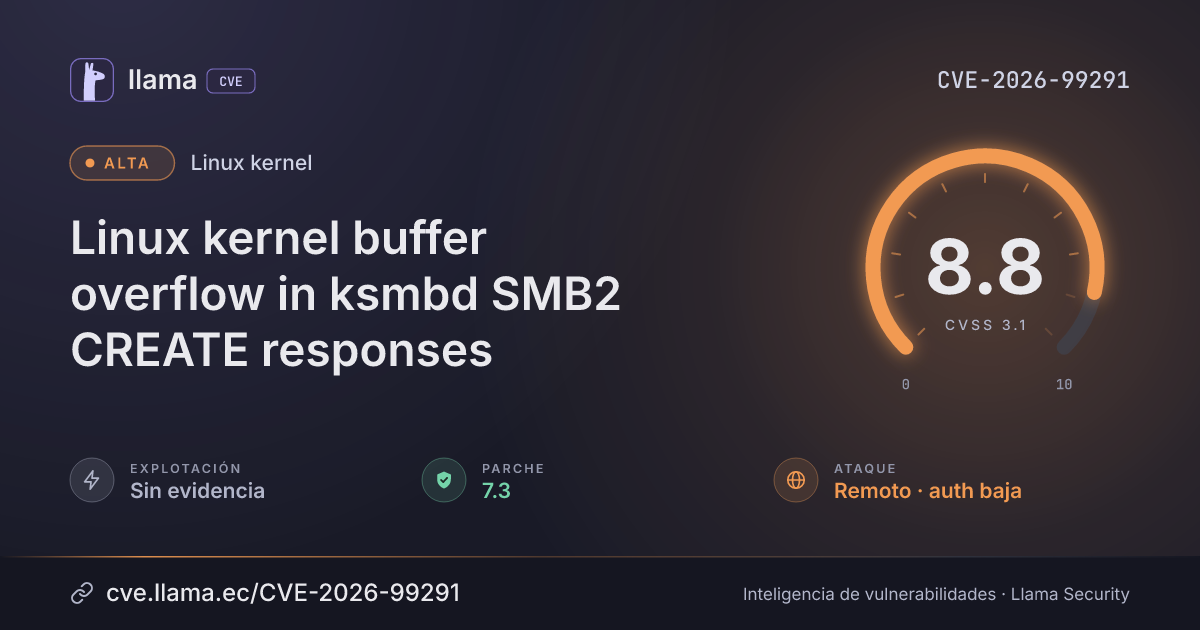
CVE-2026-99291

Linux kernel buffer overflow in ksmbd SMB2 CREATE responses

An attacker can corrupt server memory by sending a crafted SMB2 CREATE request that includes AAPL contexts.

Specific setups onlyParche disponibleksmbd
Descargar PNG JSON
CVSS 3.1
8.8
Alta
CVSS:3.1/AV:N/AC:L/PR:L/UI:N/S:U/C:H/I:H/A:H Fuente: CNA
ExplotaciónSin evidenciaNo figura en CISA KEV
Exploits públicos0Ninguno conocido
Parche1 versión7.3
Exposición4 dDesde la divulgación, 16 nov 2026, 4:59 a. m.
Detección8 minDesde la divulgación hasta su ingreso al índice
Timeline

Ciclo de vida de la vulnerabilidad

Hoy
Divulgación
Publicada
Modificada
Explotación
Remediación
Monitoreo
Detectada +2
Verificada
16 nov 26
19 nov 26
20 nov 26
16 nov 26
17 nov 26
18 nov 26
19 nov 26
20 nov 26
FechaFaseEventoDetalle
Divulgación Publicada CVE-2026-99291 divulgada · CVSS 8.8 (CNA)
Monitoreo Detectada Ingresó al índice
Monitoreo Fuente: NIST NVD Registro visto por primera vez en NIST NVD
Monitoreo Fuente: ENISA EUVD Registro visto por primera vez en ENISA EUVD
Divulgación Modificada Última actualización del registro
Monitoreo Verificada Última verificación contra las fuentes
Resumen
Resumen generado por IA · CC-BY 4.0 · 16 nov 2026

The ksmbd server in the Linux kernel has a buffer overflow in how it builds responses to SMB2 CREATE requests, which can write past the end of a memory buffer. The overflow happens when a request includes AAPL response contexts, because the buffer is too small for the response.

¿Qué significa?The ksmbd SMB server in the Linux kernel can perform an out-of-bounds heap write when it handles an SMB2 CREATE request from a remote client. The write lands in kernel memory and can crash the kernel or zero neighboring kernel objects, and the advisory says it could possibly disclose kernel memory.
¿Quién está afectado?The product range lists Linux kernel versions from 7.2.6 up to, but not including, 7.3. The bug needs a share configured as a Time Machine share and an SMB 3.1.1 CREATE carrying a v2 lease and the AAPL server query context. To check the kernel version, run uname -r, and to check the share setup, look at the ksmbd share configuration for the Time Machine flag.
¿Qué hacer?The checked facts name no fixed version or patch identifiers, so no upgrade target can be confirmed from them. Check the Linux kernel advisory or the stable-kernel release notes for the fixed version before deciding what to install.
Descripción original del registro (Linux)

In the Linux kernel, the following vulnerability has been resolved: ksmbd: fix SMB2 CREATE response buffer overflow smb2_allocate_rsp_buf() uses the MAX_CIFS_SMALL_BUFFER_SIZE (448-byte) buffer for a single SMB2_CREATE response. That buffer also holds a 4-byte length field, which only leaves 444 bytes for the SMB2 body. The AAPL response made this buffer too small. After 8f1b796ff113, a request with AAPL response contexts may need at least 456 bytes. In the 456-byte case, create_aapl_rsp_buf() is appended last, clears 128 bytes, and writes 12 bytes past the allocation. KASAN reports: BUG: KASAN: slab-out-of-bounds in create_aapl_rsp_buf+0x31/0x6e0 Write of size 128 at addr ffff88800370954c by task kworker/0:0/9 ... create_aapl_rsp_buf+0x31/0x6e0 smb2_open+0x58f9/0xef10 ... smb2_allocate_rsp_buf+0x19d/0x370 ... The buggy address is located 332 bytes inside of allocated 448-byte region [ffff888003709400, ffff8880037095c0) Reserve enough space for any fixed CREATE response KSMBD can build. Store the required allocation size in the per-dialect values table. This keeps the small buffer for other commands and avoids using the max transaction buffer for every CREATE.

Contexto

Condiciones y alcance

Condiciones necesarias para que el fallo sea explotable
01
The ksmbd SMB server in the Linux kernel handles the SMB2 CREATE request from a remote client.“A remote SMB client sends SMB2 CREATE over TCP/445”
02
The share must be a Time Machine share, and the CREATE must carry the AAPL server query context.“smb2_open() sets aapl_ctxt only if the share has KSMBD_SHARE_FLAG_TIME_MACHINE”
03
The CREATE uses SMB 3.1.1 and carries a v2 lease, MxAc, QFid, and a POSIX context.“One unchained SMB 3.1.1 CREATE carrying a v2 lease (KSMBD_GLOBAL_FLAG_SMB2_LEASES and oplocks default on)”
Vector CVSS 3.1

Desglose de métricas

Opción resaltada = valor del vector · izquierda = peor caso · CNA
Vector de ataqueAV:N
RedAdyacenteLocalFísica
ComplejidadAC:L
BajaAlta
PrivilegiosPR:L
NingunoBajosAltos
InteracciónUI:N
NingunaRequerida
AlcanceS:U
CambiadoSin cambio
ConfidencialidadC:H
AltoBajoNinguno
IntegridadI:H
AltoBajoNinguno
DisponibilidadA:H
AltoBajoNinguno
Versiones

Rangos afectados

Afectada Corregida
Linux≥ 7.2.6 < 7.3
7.2.6
7.3
Remediación

Estado del parche por paquete

Paquete / productoEstadoCorregida enDesde divulgaciónÚltima versión
Linux
Corregida 7.3 — —
Versiones corregidas7.3
Explotación

Arsenal público

Sin exploits, módulos ni PoC públicos conocidos a la fecha de verificación.

Registro
EscenarioAV:N - A remote SMB client sends SMB2 CREATE over TCP/445. ksmbd_conn_handler_loop() reads that PDU, __handle_ksmbd_work() calls smb2_allocate_rsp_buf() which used a 448-byte buffer for a non-compound SMB2_CREATE_HE, then smb2_open(). The CREATE's AAPL, MxAc, QFid, POSIX, and lease contexts are the attacker-supplied bytes that make create_aapl_rsp_buf() write past that buffer. AC:L - smb2_open() sets aapl_ctxt only if the share has KSMBD_SHARE_FLAG_TIME_MACHINE and the CREATE AAPL cmd is SMB2_CRTCTX_AAPL_SERVER_QUERY; create_aapl_rsp_buf() then always memset()s 128 bytes. One unchained SMB 3.1.1 CREATE carrying a v2 lease (KSMBD_GLOBAL_FLAG_SMB2_LEASES and oplocks default on), MxAc, QFid, and a client-negotiated POSIX context places that memset past the 448-byte buffer. The client builds this request; there is no race. PR:L - create_aapl_rsp_buf() runs only from smb2_open(), and __handle_ksmbd_work() reaches that proc only after smb2_check_user_session() accepts a SMB2_SESSION_VALID SessionId and smb2_get_ksmbd_tcon() resolves a tree connect. CREATE is not on the negotiate/session-setup exemption, so this is an authenticated share user; guest ok and map to guest default off. UI:N - The attacker connects, authenticates, tree-connects, and sends the SMB2 CREATE that smb2_open() turns into the AAPL response. create_aapl_rsp_buf() runs in that request's kworker with no victim mount or other action. S:U - The overflow corrupts kernel heap beside the response buffer from smb2_allocate_rsp_buf(), which is the same host-kernel security authority as ksmbd. C:H - On SMB 3.1.1, a granted v2 lease (create_lease_size 80) plus MxAc, QFid, and the POSIX context puts create_aapl_rsp_buf()'s 128-byte memset at offset 412 of the 448-byte buffer, so 28 bytes land in the next kmalloc-512 object (60 bytes if KSMBD_GLOBAL_FLAG_DURABLE_HANDLE is also set). Zeroing that neighbor, including a freelist pointer, is a heap primitive that can disclose kernel memory. I:H - create_aapl_rsp_buf() memset()s AAPL_RSP_MAX_SIZE (128) bytes at rsp->Buffer plus the earlier CREATE contexts. On SMB 3.1.1 with a v2 lease, MxAc, QFid, and POSIX, that region starts at offset 412 of the 448-byte buffer and zeros 28 bytes of the next kmalloc-512 object, an out-of-bounds write into allocator or object state. A:H - KASAN reports a 128-byte slab-out-of-bounds write in create_aapl_rsp_buf() at offset 332 of the 448-byte CREATE buffer, 12 bytes past the object in that trace. The SMB 3.1.1 layout extends the same memset into the following kmalloc object, which oopses the kworker and can panic the kernel.Linux
Referencias
Otrahttps://git.kernel.org/stable/c/824a572c0f909ca51fdb7e18e4eee33ca7896c7a
Otrahttps://git.kernel.org/stable/c/713c31a3a225b6239a37ac7fbfb394567f8b3519

Las referencias externas se muestran para copiar: cve.llama.ec no lo redirige a otros sitios.