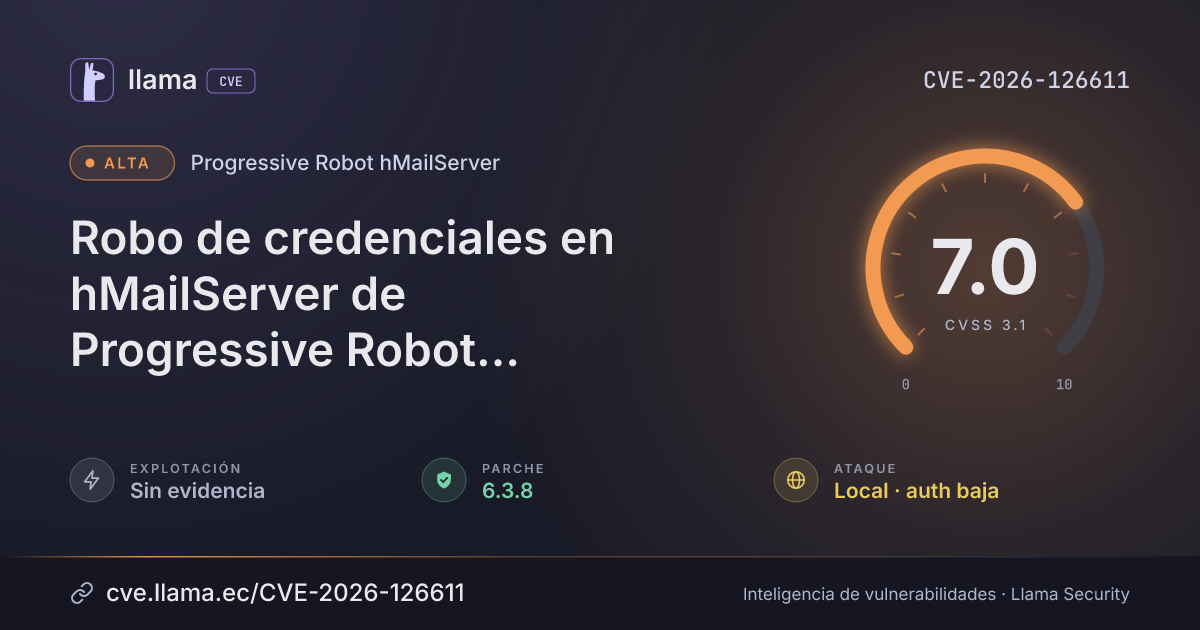
CVE-2026-126611
Progressive Robot hMailServer credential theft via database connection certificate flaw
A local attacker who can impersonate the database server can steal its login password and read or alter traffic to it.
CVSS:3.1/AV:L/AC:H/PR:L/UI:N/S:U/C:H/I:H/A:H
Fuente: CNA
Ciclo de vida de la vulnerabilidad
| Fecha | Fase | Evento | Detalle |
|---|---|---|---|
| Divulgación | Publicada | CVE-2026-126611 divulgada · CVSS 7 (CNA) | |
| Monitoreo | Detectada | Ingresó al índice | |
| Monitoreo | Fuente: NIST NVD | Registro visto por primera vez en NIST NVD | |
| Monitoreo | Fuente: ENISA EUVD | Registro visto por primera vez en ENISA EUVD | |
| Monitoreo | Fuente: OSV | Registro visto por primera vez en OSV | |
| Divulgación | Evaluación SSVC | CISA-ADP · explotación ninguna | |
| Divulgación | Modificada | Última actualización del registro | |
| Monitoreo | Verificada | Última verificación contra las fuentes |
Progressive Robot Ltd's hMailServer fails to verify the database server's certificate when it connects to a local MySQL or MariaDB database, but only under a non-default configuration. A local attacker with low privileges who can impersonate the database server, such as by listening on its port while it is stopped or restarting, can capture the database login password and read and modify traffic between hMailServer and the database.
Descripción original del registro (GitLab)
Progressive Robot hMailServer 6.3.4 through 6.3.7, with a MySQL or MariaDB database, TlsMode=verify-full and no TlsCaFile, does not verify the database server's certificate's issuer or name when the connection is one that MariaDB Connector/C treats as local - Server= set to 127.0.0.1, ::1 or localhost (on Linux a Unix socket), to . on Windows (a named pipe), or to a comma-separated list of servers that holds such an element - which allows a local attacker who can stand in for the database server, for example by listening on its port while it is stopped or restarting, to receive the database sign-in, the password included, and to read and modify the traffic between hMailServer and its database. hMailServer applied verify-full by turning the client's certificate verification on without a CA file, but MariaDB Connector/C 3.4.1 and later, on a connection they treat as local and with no CA file, accept any certificate within its validity period that is self-signed or sent with its own root, for any name (Connector/C 3.4.2 to 3.4.10 also one whose issuer they cannot find), so the client accepted the certificate an impostor made, asked no proof of the password and allowed a switch to an authentication method that sends the password unhashed, while hmailserver --check-database said the certificate had been checked against the system's trust store and the application log that it had been checked. The Windows builds bundle Connector/C 3.4.9 (6.3.4 to 6.3.6) and 3.4.11 (6.3.7); on Linux the distribution's client is used, and Connector/C 3.3 and 3.4.0 and Oracle's MySQL client are not affected. The configuration is not the default: TlsMode defaults to prefer, which checks no certificate.
Condiciones y alcance
Desglose de métricas
Rangos afectados
Estado del parche por paquete
| Paquete / producto | Estado | Corregida en | Desde divulgación | Última versión |
|---|---|---|---|---|
hMailServer |
Corregida | 6.3.8 | — | — |
6.3.8Arsenal público
Sin exploits, módulos ni PoC públicos conocidos a la fecha de verificación.
https://gitlab.com/hmailserver/hmailserver/-/work_items/113https://gitlab.com/hmailserver/hmailserver/-/releases/v6.3.8Las referencias externas se muestran para copiar: cve.llama.ec no lo redirige a otros sitios.