llamaCVEVulnerability Intelligence
/
Linux kernel

CVE-2026-99317

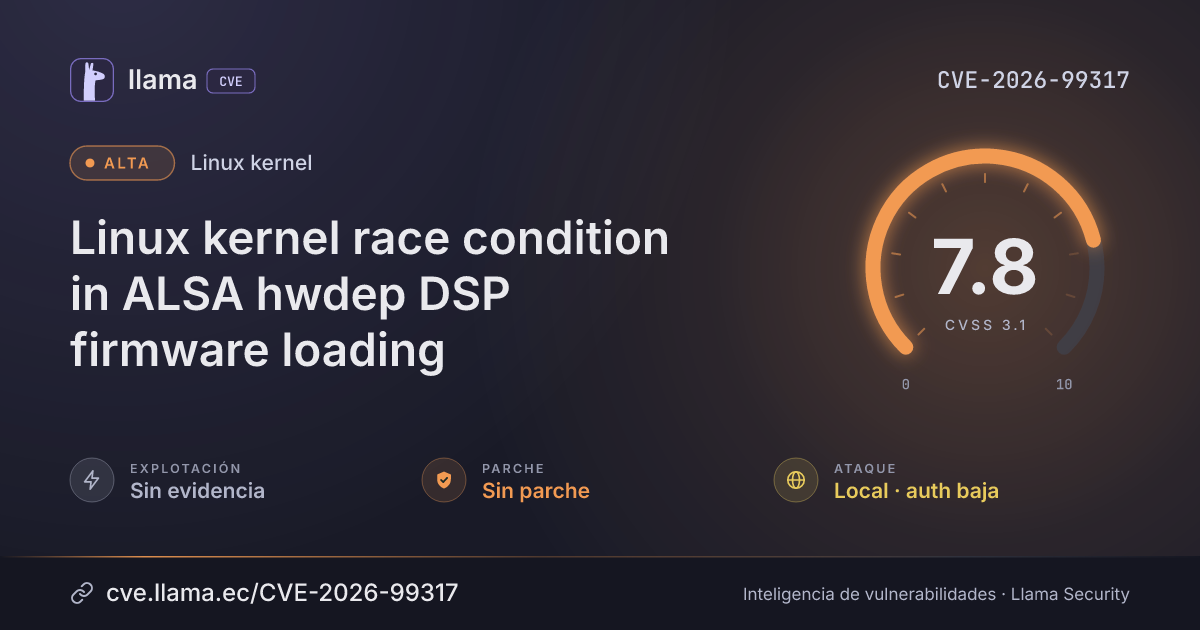
Linux kernel race condition in ALSA hwdep DSP firmware loading

A local user can race firmware load requests to trigger a kernel warning and double-allocate buffers.

Specific setups onlySin parche publicado
Descargar PNG JSON
CVSS 3.1
7.8
Alta
CVSS:3.1/AV:L/AC:L/PR:L/UI:N/S:U/C:H/I:H/A:H Fuente: CNA
ExplotaciónSin evidenciaNo figura en CISA KEV
Exploits públicos0Ninguno conocido
ParcheSin parcheEl fabricante no ha publicado corrección
Exposición1 dDesde la divulgación, 18 nov 2026, 3:42 a. m.
Detección13 minDesde la divulgación hasta su ingreso al índice
Timeline

Ciclo de vida de la vulnerabilidad

Hoy
Divulgación
Publicada
Modificada
Explotación
Remediación
Monitoreo
Detectada
Fuente: NIST NVD +1
Verificada
03:42 a. m.
04:27 a. m.
08:52 a. m.
12:58 a. m.
03:42 a. m.
03:01 p. m.
02:20 a. m.
01:39 p. m.
12:58 a. m.
FechaFaseEventoDetalle
Divulgación Publicada CVE-2026-99317 divulgada · CVSS 7.8 (CNA)
Monitoreo Detectada Ingresó al índice
Monitoreo Fuente: NIST NVD Registro visto por primera vez en NIST NVD
Monitoreo Fuente: ENISA EUVD Registro visto por primera vez en ENISA EUVD
Divulgación Modificada Última actualización del registro
Monitoreo Verificada Última verificación contra las fuentes
Resumen
Resumen generado por IA · CC-BY 4.0 · 18 nov 2026

The ALSA hwdep interface in the Linux kernel lets concurrent DSP firmware load requests on a shared file descriptor, from threads or after fork, both pass the check that a firmware index is unloaded. This can trigger a kernel warning in the snd-usb-usx2y driver and allocate its sequence URBs twice.

¿Qué significa?The bug is a race in the Linux kernel's ALSA hwdep DSP loading. When two SNDRV_HWDEP_IOCTL_DSP_LOAD requests for the same index run at once on one shared hwdep file descriptor, they can collide. The advisory's CVSS scenario says a local user could cause kernel oopses or livelocks, and use-after-free style writes through a reclaimed URB pointer.
¿Quién está afectado?The advisory ties the issue to the snd-usb-usx2y driver for US-x2y devices, the only driver callback being snd_usx2y_hwdep_dsp_load. The facts give no affected version range, so check the kernel version and whether this driver and hardware are in use on the system.
¿Qué hacer?The checked facts name no fixed kernel version and no patch identifiers, so no upgrade target can be given from them. Check the kernel advisory or the stable kernel update for this CVE for the fix.
no-patchThe checked facts describe no workaround. Limiting use of the snd-usb-usx2y driver with US-x2y devices is the only step the facts point to, and the advisory's own guidance should be checked for anything more specific.
Descripción original del registro (Linux)

In the Linux kernel, the following vulnerability has been resolved: ALSA: hwdep: Serialize DSP load requests The check of the loaded DSP indices and the call of the driver's dsp_load callback in snd_hwdep_dsp_load() are not serialized. A hwdep file descriptor can be shared among threads, or inherited across fork, so two SNDRV_HWDEP_IOCTL_DSP_LOAD requests for the same index can both observe the index as unloaded and enter the driver's callback concurrently, even though the device itself is opened exclusively. This breaks the assumption behind hw->dsp_loaded that a firmware index is loaded only once. For example, snd-usb-usx2y hits WARN_ON(usx2y->as04.buffer) in usx2y_async_seq04_init() and may allocate the US-428 sequence URBs twice. Serialize the check, the callback invocation and the bookkeeping with a per-hwdep mutex, so that the second request returns -EBUSY.

Contexto

Condiciones y alcance

Condiciones necesarias para que el fallo sea explotable
01
Linux kernel with ALSA hwdep DSP loading, exercised by the snd-usb-usx2y driver for US-x2y devices“The only driver callback is snd_usx2y_hwdep_dsp_load”
02
Two DSP load requests for the same index race on one shared hwdep file descriptor“two SNDRV_HWDEP_IOCTL_DSP_LOAD requests for the same index can both”
¿Quién debe revisar?Teams running Linux kernels with ALSA hwdep DSP loading, such as snd-usb-usx2y for US-x2y audio interfaces
Vector CVSS 3.1

Desglose de métricas

Opción resaltada = valor del vector · izquierda = peor caso · CNA
Vector de ataqueAV:L
RedAdyacenteLocalFísica
ComplejidadAC:L
BajaAlta
PrivilegiosPR:L
NingunoBajosAltos
InteracciónUI:N
NingunaRequerida
AlcanceS:U
CambiadoSin cambio
ConfidencialidadC:H
AltoBajoNinguno
IntegridadI:H
AltoBajoNinguno
DisponibilidadA:H
AltoBajoNinguno
Versiones

Versiones afectadas

2.6.12
Remediación

Estado del parche por paquete

Paquete / productoEstadoCorregida enDesde divulgaciónÚltima versión
Linux
Sin parche — — —
Explotación

Arsenal público

Sin exploits, módulos ni PoC públicos conocidos a la fecha de verificación.

Registro
EscenarioAV:L - The patched snd_hwdep_dsp_load is reached from snd_hwdep_ioctl's SNDRV_HWDEP_IOCTL_DSP_LOAD on the local hwdep node (/dev/snd/hwC*D*), via snd_hwdep_dsp_load_user. The only driver callback is snd_usx2y_hwdep_dsp_load; the colliding index and image come from that ioctl, not from a remote protocol message. AC:L - A local holder of one hwdep fd (exclusive=1 still allows threads and fork to share it) issues two DSP_LOAD ioctls for index 1 while hw->dsp_loaded is clear, which the attacker gets by opening the node before usx2yloader or by replugging the US-x2y. Both calls pass the unlocked dsp_loaded test and run snd_usx2y_hwdep_dsp_load together. PR:L - snd_hwdep_open and snd_hwdep_ioctl contain no capable() check. udev grants the active session ACL on SUBSYSTEM=="sound" (uaccess, group audio), so an ordinary logged-in user can open the hwdep node and issue DSP_LOAD. UI:N - The attacker opens the fd and fires both SNDRV_HWDEP_IOCTL_DSP_LOAD calls. Firmware loading and replug, if needed to clear dsp_loaded, are the attacker's own actions. S:U - Impact stays inside the host kernel the caller is already running in: usx2ydev, its URBs, and the snd_card device list. No guest/host or IOMMU boundary is crossed. C:H - Both USB_ID_US224 and USB_ID_US428 loads call usx2y_rate_set, which kfrees the snd_usx2y_urb_seq still linked from usx2y->us04 while i_usx2y_in04_int passes us04->urb[] to usb_submit_urb. After reclaim, that urb pointer is attacker-controlled and usb_submit_urb dereferences it. I:H - i_usx2y_in04_int increments us04->submitted and usb_submit_urb writes urb->status, urb->hcpriv and the endpoint queue through the reclaimed us04->urb pointer. On USB_ID_US428 the second usx2y_audio_stream_new also stores pointers past usx2y->subs[4] into prepare_subs and prepare_wait_queue. A:H - The freed us04 URB is used in interrupt context, snd_device_new list_add races on card->devices from concurrent usx2y_create_alsa_devices, and wait_event runs on the overwritten prepare_wait_queue. Any of those oopses or livelocks the kernel; usx2y_async_seq04_init's WARN_ON(as04.buffer) is the same race when the second call loses.Linux
Referencias
Otrahttps://git.kernel.org/stable/c/200bda52a9fd604e13c57d3a548639c13bdfb19c
Otrahttps://git.kernel.org/stable/c/3634a1beb0395f02807d41a2edf4288732d3f90e
Otrahttps://git.kernel.org/stable/c/1b94ca29b1edbbdb357c2c8a9163d1d1755e4ad2
Otrahttps://git.kernel.org/stable/c/aee83c204f80d56b4d55f53acdb8594308ddcd4a

Las referencias externas se muestran para copiar: cve.llama.ec no lo redirige a otros sitios.