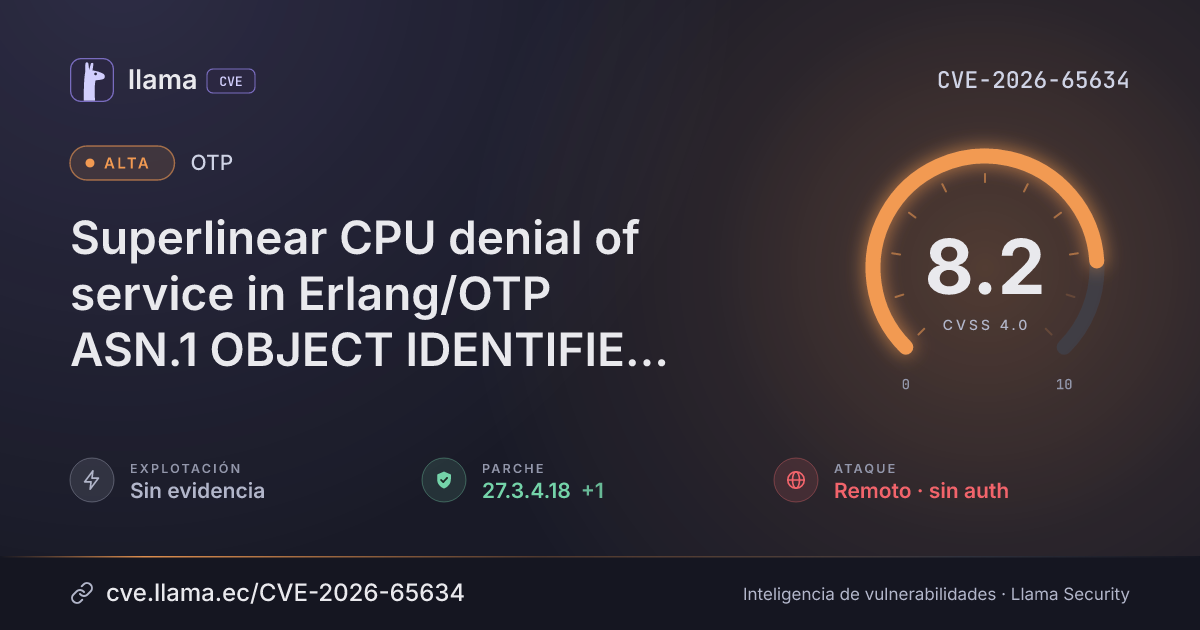
CVE-2026-65634
Superlinear CPU denial of service in Erlang/OTP ASN.1 OBJECT IDENTIFIER decoder
CVSS:4.0/AV:N/AC:L/AT:P/PR:N/UI:N/VC:N/VI:N/VA:H/SC:N/SI:N/SA:N
Fuente: CNA
Ciclo de vida de la vulnerabilidad
| Fecha | Fase | Evento | Detalle |
|---|---|---|---|
| Divulgación | Publicada | CVE-2026-65634 divulgada · CVSS 8.2 (CNA) | |
| Divulgación | Evaluación SSVC | CISA-ADP · explotación ninguna | |
| Monitoreo | Detectada | Ingresó al índice | |
| Monitoreo | Fuente: OSV | Registro visto por primera vez en OSV | |
| Divulgación | Modificada | Última actualización del registro | |
| Monitoreo | Verificada | Última verificación contra las fuentes |
Inefficient algorithmic complexity in the Erlang/OTP asn1 OBJECT IDENTIFIER decoder allows a remote unauthenticated attacker to cause denial of service by sending a crafted OID during the TLS handshake. The BER OID decoder asn1rtt_ber:dec_subidentifiers/3 in lib/asn1/src/asn1rtt_ber.erl and the equivalent PER helper asn1rtt_per_common:dec_subidentifiers/3 in lib/asn1/src/asn1rtt_per_common.erl accumulate a base-128 subidentifier into an unbounded integer using (Av bsl 7) + H per continuation byte. Each shift and addition on the growing accumulator is linear in the number of bits already accumulated, giving quadratic total work in the size of a single subidentifier. The JER helper asn1rtt_jer:json2oid/1 in lib/asn1/src/asn1rtt_jer.erl exhibits the same class of unbounded-integer parsing when decoding a dot-separated OID from JSON. A DER-encoded OBJECT IDENTIFIER with one very large arc (approximately 262 KB of continuation bytes) consumes roughly 13 seconds of CPU on typical hardware. The vulnerable decoder is generated into every ASN.1 module that contains an OBJECT IDENTIFIER, including OTP-PUB-KEY which is reached during X.509 certificate parsing via public_key:pkix_decode_cert/2. This decoder runs before any signature or trust chain verification, so any Erlang service that parses peer TLS certificates is exposed: the default for TLS clients (which always parse the server certificate) and for mutual-TLS servers (which parse client certificates). This vulnerability is associated with program files lib/asn1/src/asn1rtt_ber.erl, lib/asn1/src/asn1rtt_per_common.erl and lib/asn1/src/asn1rtt_jer.erl and program routines asn1rtt_ber:dec_subidentifiers/3, asn1rtt_per_common:dec_subidentifiers/3 and asn1rtt_jer:json2oid/1. This issue affects OTP from OTP 17.0 before OTP 27.3.4.18, OTP 28.5.0.7, and OTP 29.1.1, corresponding to asn1 from 3.0 before 5.3.4.3, 5.4.3.1, and 5.5.2. Whether OTP before OTP 17.0, corresponding to asn1 before 3.0, is affected is unknown.
Affects Erlang/OTP from 17.0 before 27.3.4.18 when the asn1 application decodes untrusted data, such as TLS with the verify_peer option. Fixed in 27.3.4.18.
Condiciones y alcance
Desglose de métricas
Rangos afectados
Estado del parche por paquete
| Paquete / producto | Estado | Corregida en | Desde divulgación | Última versión |
|---|---|---|---|---|
OTP |
Corregida | 5.3.4.3, 27.3.4.18 | — | — |
5.3.4.327.3.4.18Arsenal público
Sin exploits, módulos ni PoC públicos conocidos a la fecha de verificación.
https://github.com/erlang/otp/security/advisories/GHSA-qghx-23m5-r55mhttps://www.erlang.org/doc/system/versions.html#order-of-versionshttps://github.com/erlang/otp/commit/0fe2c02fdc06fab1c63be9db1a7456993d20f838https://cna.erlef.org/cves/CVE-2026-65634.htmlhttps://osv.dev/vulnerability/EEF-CVE-2026-65634Las referencias externas se muestran para copiar: cve.llama.ec no lo redirige a otros sitios.