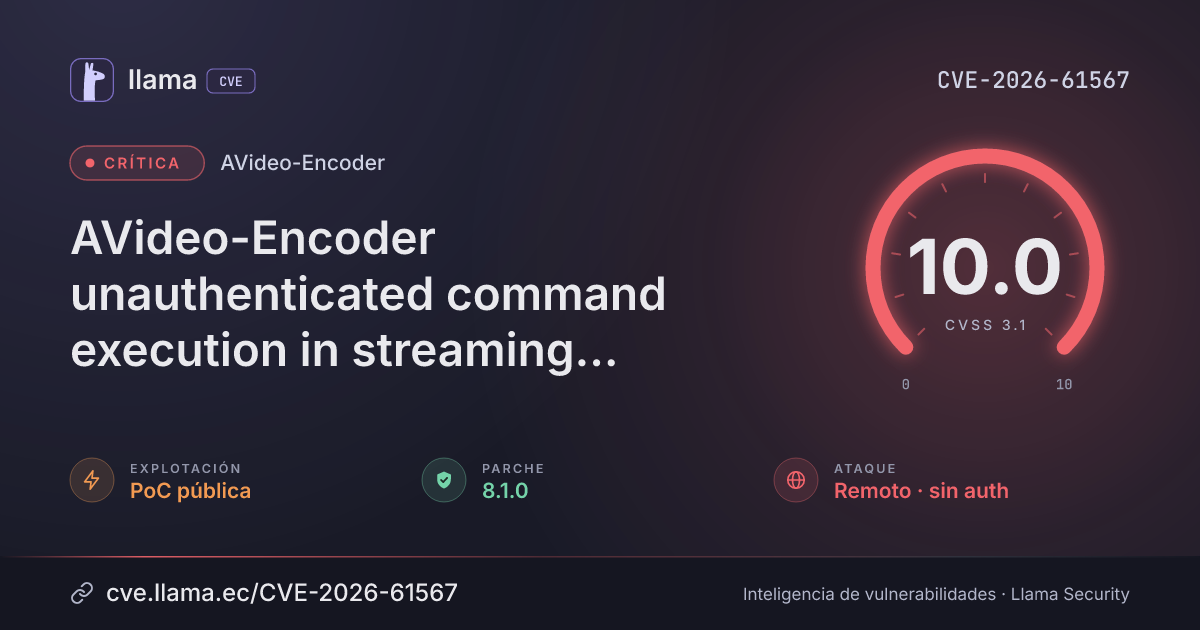
CVE-2026-61567
AVideo-Encoder unauthenticated command execution in streaming encoder
Remote attackers without logins can run commands on the server and read stored credentials.
CVSS:3.1/AV:N/AC:L/PR:N/UI:N/S:C/C:H/I:H/A:H
Fuente: CNA
Ciclo de vida de la vulnerabilidad
| Fecha | Fase | Evento | Detalle |
|---|---|---|---|
| Divulgación | Publicada | CVE-2026-61567 divulgada · CVSS 10 (CNA) | |
| Monitoreo | Detectada | Ingresó al índice | |
| Monitoreo | Fuente: NIST NVD | Registro visto por primera vez en NIST NVD | |
| Monitoreo | Fuente: ENISA EUVD | Registro visto por primera vez en ENISA EUVD | |
| Monitoreo | Fuente: OSV | Registro visto por primera vez en OSV | |
| Divulgación | Evaluación SSVC | CISA-ADP · explotación PoC pública | |
| Divulgación | Modificada | Última actualización del registro | |
| Monitoreo | Verificada | Última verificación contra las fuentes |
AVideo, an open-source video-sharing platform, is affected before version 8.1.0, specifically its live-streaming encoder component. An unauthenticated remote attacker could run arbitrary operating-system commands on the server as the web-server user, which could expose database and stored credentials, modify files, establish persistence, and disrupt the encoder service.
AVideo-Encoder 8.0 and earlier are affected, per the advisory, and the tested master snapshot 7cead80 is too. The fix is in 8.1.0.
Descripción original del registro (GitHub_M)
AVideo is a video-sharing Platform. Prior to 8.1.0, the live-streaming endpoint `view/videosListToLive.php` accepts an attacker-named streamer in `webSiteRootURL`, calls `Login::run` in `objects/Login.php`, and trusts the returned JSON as session state. An unauthenticated remote attacker who can host an HTTP service reachable by the encoder can self-grant `isLogged` and `canStream` without legitimate credentials. The endpoint requires only nonempty `playlists_id` and `APISecret` values; `APISecret` is forwarded rather than checked against a stored secret. This path never calls `Streamer::isURLAllowed` and therefore works regardless of the operator's streamer allowlist. It fetches a second attacker-controlled video-list response and interpolates `videos[].path` without shell argument escaping into `ffprobe` and `ffmpeg` commands passed to `exec`; `isAudio` calls `isVideo` to reach the `ffprobe` command. Paths containing shell delimiters execute arbitrary operating-system commands as the web-server user. The request filter does not inspect the video-list JSON. This can disclose database and stored streamer credentials, compromise the upstream platform using those credentials, modify files owned by the web-server user, establish persistence, and deny encoder service. This issue is fixed in version 8.1.0.
Condiciones y alcance
Desglose de métricas
Rangos afectados
Estado del parche por paquete
| Paquete / producto | Estado | Corregida en | Desde divulgación | Última versión |
|---|---|---|---|---|
AVideo-Encoder |
Corregida | 8.1.0 | — | — |
8.1.0Arsenal público
Sin exploits, módulos ni PoC públicos conocidos a la fecha de verificación.
https://github.com/WWBN/AVideo-Encoder/security/advisories/GHSA-rf63-6vwm-wv8phttps://github.com/WWBN/AVideo-Encoder/commit/99b8ad9b66fe5726cababbe29dce9d9695131caahttps://github.com/WWBN/AVideo-Encoder/releases/tag/v8.1.0Las referencias externas se muestran para copiar: cve.llama.ec no lo redirige a otros sitios.