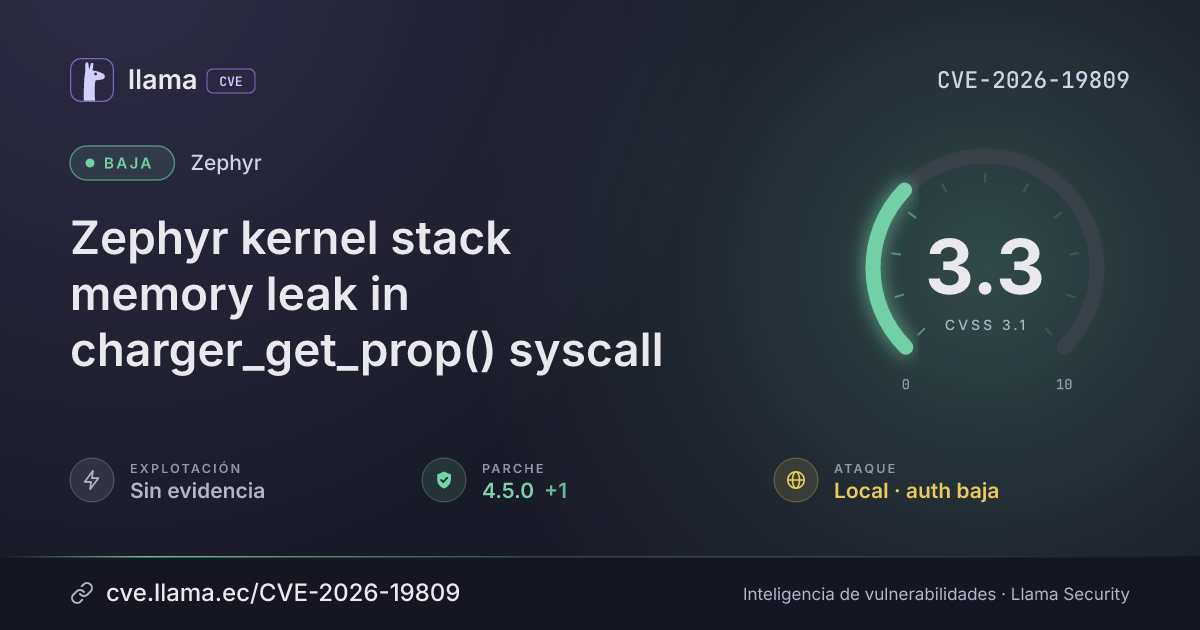
CVE-2026-19809
Zephyr kernel stack memory leak in charger_get_prop() syscall
A local user with low privileges and charger access can repeat calls to read leftover kernel stack memory.
CVSS:3.1/AV:L/AC:L/PR:L/UI:N/S:U/C:L/I:N/A:N
Fuente: CNA
Ciclo de vida de la vulnerabilidad
| Fecha | Fase | Evento | Detalle |
|---|---|---|---|
| Divulgación | Publicada | CVE-2026-19809 divulgada · CVSS 3.3 (CNA) | |
| Monitoreo | Detectada | Ingresó al índice | |
| Monitoreo | Fuente: NIST NVD | Registro visto por primera vez en NIST NVD | |
| Monitoreo | Fuente: ENISA EUVD | Registro visto por primera vez en ENISA EUVD | |
| Monitoreo | Fuente: OSV | Registro visto por primera vez en OSV | |
| Divulgación | Evaluación SSVC | CISA-ADP · explotación ninguna | |
| Divulgación | Modificada | Última actualización del registro | |
| Monitoreo | Verificada | Última verificación contra las fuentes |
The zephyr software's charger_get_prop() system call handler copies uninitialized kernel stack memory back to user-mode threads. A local user with low privileges, who has been granted access to a charger device, can repeat calls with chosen property IDs to read up to 12 to 16 bytes of kernel stack contents per call, depending on the target.
Descripción original del registro (zephyr)
The user-mode system call verifier z_vrfy_charger_get_prop() in drivers/charger/charger_handlers.c declares an uninitialized union charger_propval k_val on the kernel (privileged) stack, passes it to the charger driver back end via z_impl_charger_get_prop(), and then copies the full sizeof(union charger_propval) back into the calling user thread's buffer with k_usermode_to_copy(). That discloses kernel stack contents on two paths: On error. The copy-out ignores the driver's return code. In-tree back ends return an error without writing through the value pointer for properties they do not implement: charger_gpio_get_prop() returns -ENOTSUP unconditionally, and bq24190_get_prop() has a default: return -ENOTSUP; arm that never touches val. The whole union is then stack residue. On success. A back end writes only the one union member the requested property selects (for example sbs_charger.c writes the one-byte val->present for CHARGER_PROP_PRESENT and returns 0), yet the handler still copies the whole union, so every byte beyond that member is uninitialized. The handler is compiled only when CONFIG_USERSPACE=y and is reachable by any user-mode thread that has been granted access to a charger device object. K_SYSCALL_DRIVER_CHARGER() validates only the device object and its API pointer, not the property identifier, so an unprivileged thread can choose prop freely: an unimplemented property forces the error path, a narrow one the success path, and the call can be repeated at will. Each call discloses up to the size of the union (12 bytes on a 32-bit target, 16 bytes on 64-bit targets where the function-pointer members widen it) of supervisor-stack memory. The bytes are residue of earlier kernel-side frames on the thread's privileged stack and can contain kernel object addresses and saved return addresses, which an unprivileged thread cannot otherwise observe and which help defeat address-layout assumptions when exploiting a separate memory-safety defect. There is no integrity or availability impact. Two commits fix it, and both are needed. 5054384e983c skips the copy-out when the back end reports an error. c31cac727d02 zeroes the union before the driver call, so the bytes copied out on success are driver-written data or zeros. A tree carrying only the first still leaks on every successful call.
Desglose de métricas
Rangos afectados
Estado del parche por paquete
| Paquete / producto | Estado | Corregida en | Desde divulgación | Última versión |
|---|---|---|---|---|
zephyr |
Corregida | 4.3.2, 4.5.0 | — | — |
4.3.24.5.0Arsenal público
Sin exploits, módulos ni PoC públicos conocidos a la fecha de verificación.
https://github.com/zephyrproject-rtos/zephyr/security/advisories/GHSA-rghm-r3c9-92qchttps://github.com/zephyrproject-rtos/zephyr/commit/5054384e983c105b90d704272abcd479486ae3a2https://github.com/zephyrproject-rtos/zephyr/commit/c31cac727d029f273a67f65941985696f1882867Las referencias externas se muestran para copiar: cve.llama.ec no lo redirige a otros sitios.