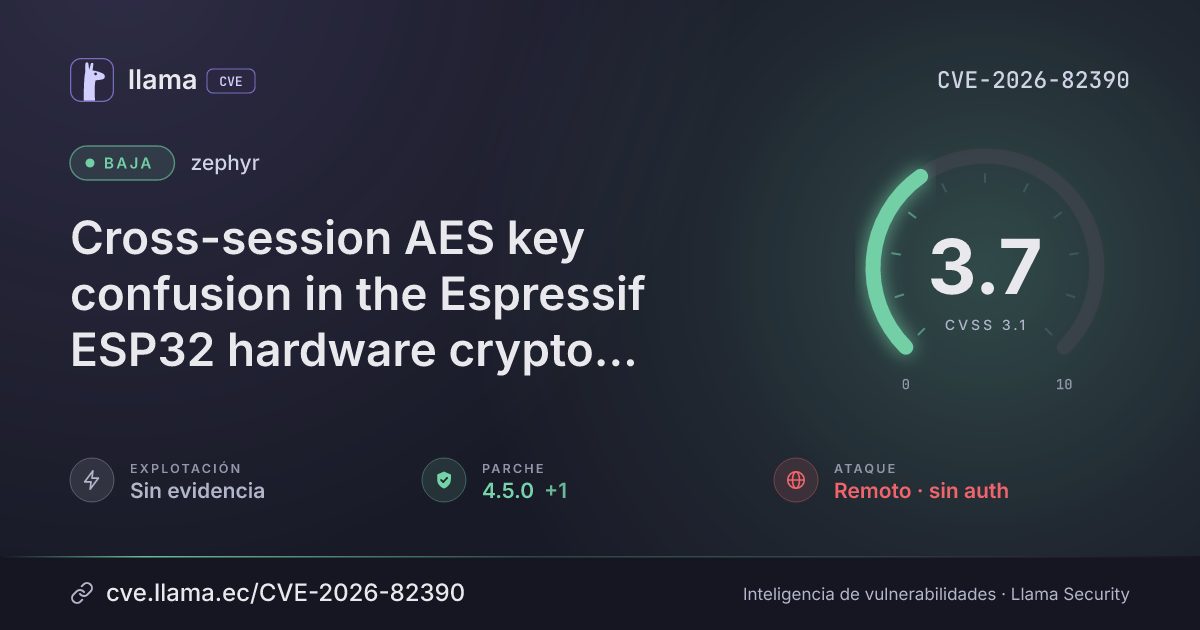
CVE-2026-82390
Cross-session AES key confusion in the Espressif ESP32 hardware crypto driver
CVSS:3.1/AV:N/AC:H/PR:N/UI:N/S:U/C:L/I:N/A:N
Fuente: CNA
Ciclo de vida de la vulnerabilidad
| Fecha | Fase | Evento | Detalle |
|---|---|---|---|
| Divulgación | Publicada | CVE-2026-82390 divulgada · CVSS 3.7 (CNA) | |
| Monitoreo | Detectada | Ingresó al índice | |
| Divulgación | Evaluación SSVC | CISA-ADP · explotación ninguna | |
| Monitoreo | Fuente: NIST NVD | Registro visto por primera vez en NIST NVD | |
| Monitoreo | Fuente: ENISA EUVD | Registro visto por primera vez en ENISA EUVD | |
| Divulgación | Modificada | Última actualización del registro | |
| Monitoreo | Fuente: OSV | Registro visto por primera vez en OSV | |
| Monitoreo | Verificada | Última verificación contra las fuentes |
The AES cryptographic driver for Espressif ESP32 chips, used by applications that open multiple concurrent cipher sessions, can silently apply the wrong key or direction to an operation. This can cause data to be encrypted or decrypted under another session's key, which may expose plaintext to whoever controls that key.
Descripción original del registro (zephyr)
The Espressif AES driver drivers/crypto/crypto_esp32_aes.c advertises a multi-session cipher API — it hands out up to CONFIG_ESP32_CRYPTO_AES_SESSIONS_MAX (default 4) independent sessions, each carrying its own key and direction. The AES peripheral, however, has a single chip-global set of key and mode registers, and aes_begin_session() programmed them exactly once, at session start, outside the aes_lock mutex that serialises the transforms. The per-operation handlers aes_ecb_op(), aes_cbc_op() and aes_ctr_op() then ran aes_hal_transform_block() against whatever key and direction the registers happened to hold. As a result, once a second session is opened with a different key, every subsequent operation on the first session silently uses the second session's key and direction, and no error is reported. Because the key programming happened outside the lock, the correct usage pattern of "each thread does begin, then op, then free on its own session" also races: a second thread's cipher_begin_session() landing between the first thread's begin and its operation makes that operation run under the second thread's key. An attacker who can induce session creation on the device — for example a protocol peer whose connection causes a session key to be installed — can influence which key is resident when a victim operation runs. The impact is a cryptographic failure rather than memory corruption: data the application believed it was protecting under one key is encrypted or decrypted under another. Where the resident key is one the attacker knows or supplied, the affected plaintext becomes recoverable by that attacker, and the operation's direction (encrypt versus decrypt) can likewise be inverted. Exposure requires an application that holds two or more concurrent sessions with different keys against this driver; no in-tree Zephyr subsystem does so today (the 802.15.4 security layer, which does open two sessions, uses CCM mode, which this driver rejects), so the risk falls on application code that uses the documented multi-session API. The fix removes all hardware access from aes_begin_session() and reprograms the key and direction at the top of every operation, inside aes_lock, so the chip-global registers can no longer be observed stale by another session.
Desglose de métricas
Rangos afectados
Estado del parche por paquete
| Paquete / producto | Estado | Corregida en | Desde divulgación | Última versión |
|---|---|---|---|---|
zephyr |
Corregida | 4.3.2, 4.5.0 | — | — |
4.3.24.5.0Arsenal público
Sin exploits, módulos ni PoC públicos conocidos a la fecha de verificación.
https://github.com/zephyrproject-rtos/zephyr/security/advisories/GHSA-rvww-w3mx-r99qhttps://github.com/zephyrproject-rtos/zephyr/commit/cb4168ab3f6bd1bfc26060fd33cfcd00e8e641f1Las referencias externas se muestran para copiar: cve.llama.ec no lo redirige a otros sitios.