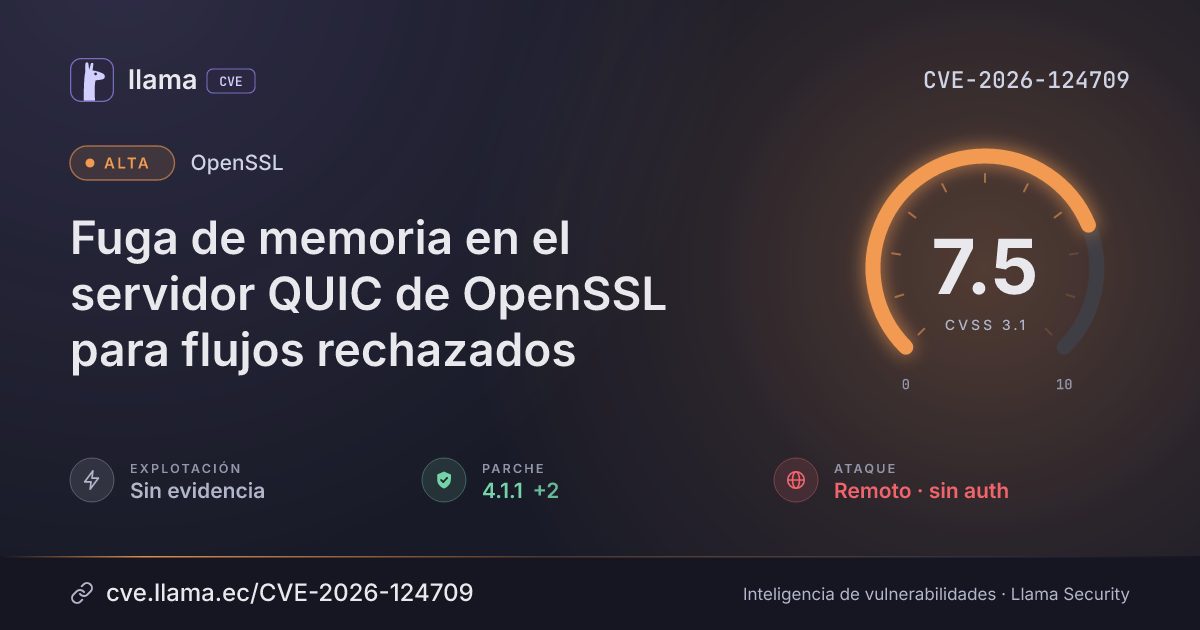
CVE-2026-124709
OpenSSL memory leak in QUIC server for rejected streams
A remote client can repeatedly open and reset streams to exhaust server memory and drop connections.
CVSS:3.1/AV:N/AC:L/PR:N/UI:N/S:U/C:N/I:N/A:H
Fuente: CISA-ADP
Ciclo de vida de la vulnerabilidad
| Fecha | Fase | Evento | Detalle |
|---|---|---|---|
| Divulgación | Publicada | CVE-2026-124709 divulgada · CVSS 7.5 (CISA-ADP) | |
| Monitoreo | Detectada | Ingresó al índice | |
| Monitoreo | Fuente: NIST NVD | Registro visto por primera vez en NIST NVD | |
| Monitoreo | Fuente: ENISA EUVD | Registro visto por primera vez en ENISA EUVD | |
| Divulgación | Evaluación SSVC | CISA-ADP · explotación ninguna | |
| Divulgación | Modificada | Última actualización del registro | |
| Monitoreo | Verificada | Última verificación contra las fuentes |
OpenSSL's QUIC server keeps state for rejected streams when the peer resets them before the rejection is signalled. A remote client that completes the QUIC handshake can repeatedly open and reset streams, growing server memory until the process runs out of memory and its connections are lost.
Affects OpenSSL 3.5.0 to 3.5.10, 4.0.0 to 4.0.4 and 4.1.0 QUIC servers with a default stream and rejected incoming streams. Fixed in 3.5.10, 4.0.4 and 4.1.1.
Descripción original del registro (openssl)
Issue summary: A QUIC server that rejects a stream opened by the peer may retain that stream's state for the lifetime of the connection if the peer resets the stream before the rejection is signalled, even though the peer's stream credit is returned. Impact summary: A remote client that completes a QUIC handshake can repeatedly open and reset streams, causing server memory to grow without bound until the process runs out of memory and every connection on it is lost. This is a Denial of Service. CWE: CWE-401: Missing Release of Memory after Effective Lifetime Description: QUIC servers track each stream the peer opens. When the incoming stream policy rejects a stream, OpenSSL schedules a STOP_SENDING frame, marks the stream deleted and returns the peer's stream credit. A deleted stream is collected only once its receive part is fully drained, which for a rejected stream means the STOP_SENDING has been acknowledged. If the peer sends RESET_STREAM first, the reset cancels the pending STOP_SENDING, so it is never sent or acknowledged and the stream is never collected. The default configuration reaches this path. Once a connection has a default stream, meaning the application has read from or written to the connection as the tutorial server does, the effective incoming stream policy rejects streams the application does not accept. Applications that set the REJECT policy explicitly are affected too. Each retained stream costs about 300 bytes, and the peer's stream credit window paces how quickly they accumulate. A client that keeps the connection open and keeps opening and resetting streams grows server memory without bound. The severity is Low because growth is slow, needs a long-lived connection, and causes no memory corruption or disclosure. FIPS impact: no The affected code is outside the FIPS module boundary.
Condiciones y alcance
Desglose de métricas
Rangos afectados
Estado del parche por paquete
| Paquete / producto | Estado | Corregida en | Desde divulgación | Última versión |
|---|---|---|---|---|
OpenSSL |
Corregida | 3.5.10, 4.0.4, 4.1.1 | — | — |
3.5.104.0.44.1.1Arsenal público
Sin exploits, módulos ni PoC públicos conocidos a la fecha de verificación.
https://openssl-library.org/news/secadv/20261117.txthttps://github.com/openssl/openssl/commit/ead311df1037e7994a6d86c7e862d71ad59c52c7https://github.com/openssl/openssl/commit/22291a6af12f158fbb13bfbd572a33dbdbf290d2https://github.com/openssl/openssl/commit/f3acb0a3328046741479482c51cec815839e1b05Las referencias externas se muestran para copiar: cve.llama.ec no lo redirige a otros sitios.