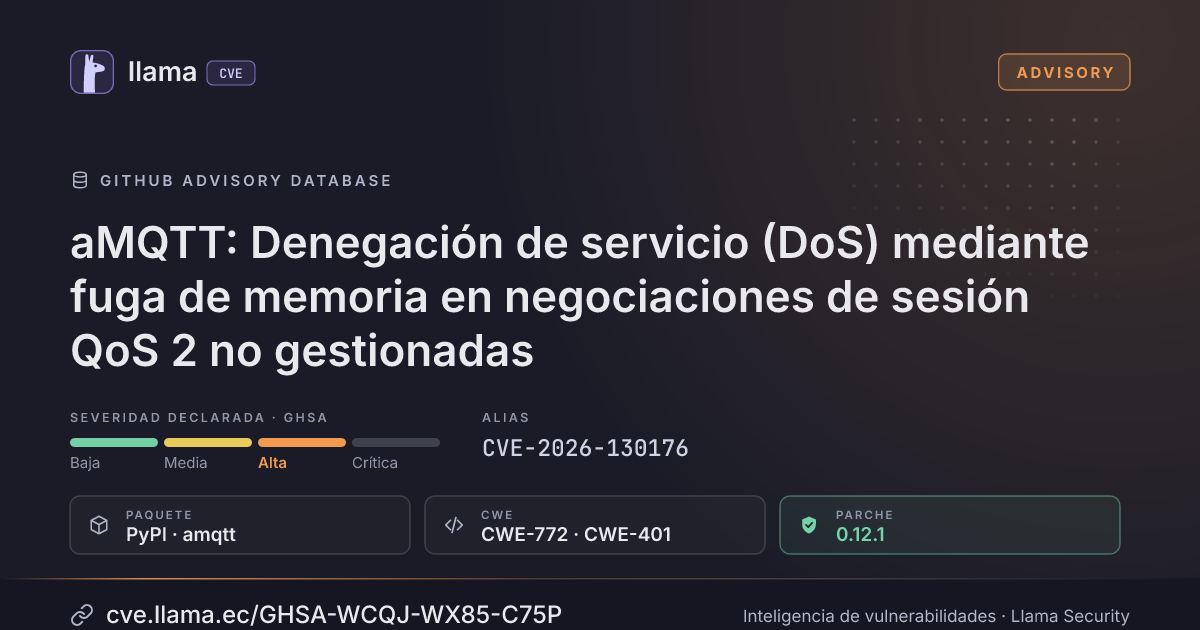
GHSA-WCQJ-WX85-C75P
aMQTT: Denial of Service (DoS) via Memory Leak in Unmanaged QoS 2 Session Handshakes
Texto original en inglés · Ver en español
Ciclo de vida de la vulnerabilidad
| Fecha | Fase | Evento | Detalle |
|---|---|---|---|
| Divulgación | Publicada | GHSA-WCQJ-WX85-C75P divulgada | |
| Divulgación | Modificada | Última actualización del registro | |
| Monitoreo | Detectada | Ingresó al índice | |
| Monitoreo | Verificada | Última verificación contra las fuentes |
Impact
`amqtt` is vulnerable to a remote denial of service caused by incomplete MQTT QoS 2 transactions remaining allocated after the associated client disconnects.
MQTT QoS 2 uses a four-step handshake to provide exactly-once delivery. If a client begins a QoS 2 transaction but disconnects before the handshake completes, `amqtt` retains the associated transaction state and packet identifier without an expiration mechanism to remove it.
QoS 1 transactions are protected by a timeout mechanism, which defaults to 5 seconds, allowing abandoned state to be released. Equivalent timeout handling was not applied to incomplete QoS 2 transactions.
An attacker can repeatedly connect to the broker, initiate QoS 2 transactions, and disconnect before completing the handshake. Each incomplete transaction leaves state allocated in memory. Repeating this process causes broker memory consumption to grow continuously.
Successful exploitation can cause:
- Unbounded growth in broker memory usage
- Accumulation of incomplete QoS 2 transaction state
- Increasing memory pressure on the host system
- Termination of the broker process when available memory is exhausted
- Operating-system Out-Of-Memory (OOM) intervention
- Complete loss of availability for the affected broker process
Exploitation does not require maintaining long-lived connections. An attacker can create incomplete QoS 2 transactions and disconnect, leaving the broker to retain the associated state after the network connection has closed.
Under the default configuration, anonymous clients can exploit the vulnerability without credentials. When authentication is enabled, any authenticated client permitted to initiate QoS 2 message flows may still be able to exploit it. Authentication alone is therefore not a sufficient mitigation.
- Ecosystem: `pip`
- Package: `amqtt`
- Affected versions: `>= 0.11.0, <= 0.12.0`
The vulnerable code is present in the v0.11.0 release commit, 352678c87e50e501a8a5bb91fab73c9400fa046c, and remained present on the main branch as of 5ebbf366f6b79ab12a06f426ffd18ff28954e4ea. Versions before 0.11.0 were not evaluated.
This is a denial-of-service vulnerability only. No confidentiality or integrity impact has been identified. Successful exploitation causes degradation and eventual loss of availability through memory exhaustion.
Patches
The issue will be been patched in the `v0.12.1` released version; all users should upgrade.
The completed fix:
- Apply transaction expiration handling consistently to incomplete QoS 1 and QoS 2 message flows
- Expire abandoned QoS 2 state when the associated transaction does not complete within the configured timeout
- Release the associated message state and packet identifiers when the transaction expires
- Prevent disconnected clients from leaving incomplete QoS 2 transactions resident in broker memory indefinitely
The fixing commit is `2755fd801a6f95e9b73e11116948b57a95348466` https://github.com/Yakifo/amqtt/commit/2755fd801a6f95e9b73e11116948b57a95348466
Workarounds
Administrators who cannot immediately upgrade should limit the ability of untrusted clients to create large numbers of incomplete QoS 2 transactions.
Where application requirements permit, preventing untrusted clients from using QoS 2 provides the strongest temporary mitigation.
Connection and request rate limiting at a reverse proxy, load balancer, firewall, or other network layer can reduce the rate at which an attacker creates abandoned transactions, but does not eliminate the underlying vulnerability. An attacker able to continue creating incomplete QoS 2 transactions can still cause memory usage to increase over time.
Administrators should also monitor broker memory consumption and configure appropriate process or container memory limits to prevent exhaustion of host resources. Restarting the broker may reclaim abandoned state and restore availability, but the broker remains vulnerable until the patched version is installed.
MQTT Keep Alive limits are not a sufficient mitigation because the vulnerable state persists after the client connection has already terminated.
Incluye detalles técnicos publicados por el investigador. Úselos solo para validar y corregir sus propios sistemas.
Rangos afectados
Estado del parche por paquete
| Paquete / producto | Estado | Corregida en | Desde divulgación | Última versión |
|---|---|---|---|---|
PyPIamqtt |
Corregida | 0.12.1 | — | — |
0.12.1Arsenal público
Sin exploits, módulos ni PoC públicos conocidos a la fecha de verificación.
https://nvd.nist.gov/vuln/detail/CVE-2026-130176https://github.com/Yakifo/amqtt/security/advisories/GHSA-wcqj-wx85-c75phttps://github.com/Yakifo/amqtt/pull/404https://github.com/Yakifo/amqtt/commit/2755fd801a6f95e9b73e11116948b57a95348466https://github.com/Yakifo/amqtt/commit/64a6f8c3ebc47640f2e092885c1d504c8f34f1afhttps://github.com/Yakifo/amqtthttps://github.com/Yakifo/amqtt/releases/tag/v0.12.1Las referencias externas se muestran para copiar: cve.llama.ec no lo redirige a otros sitios.