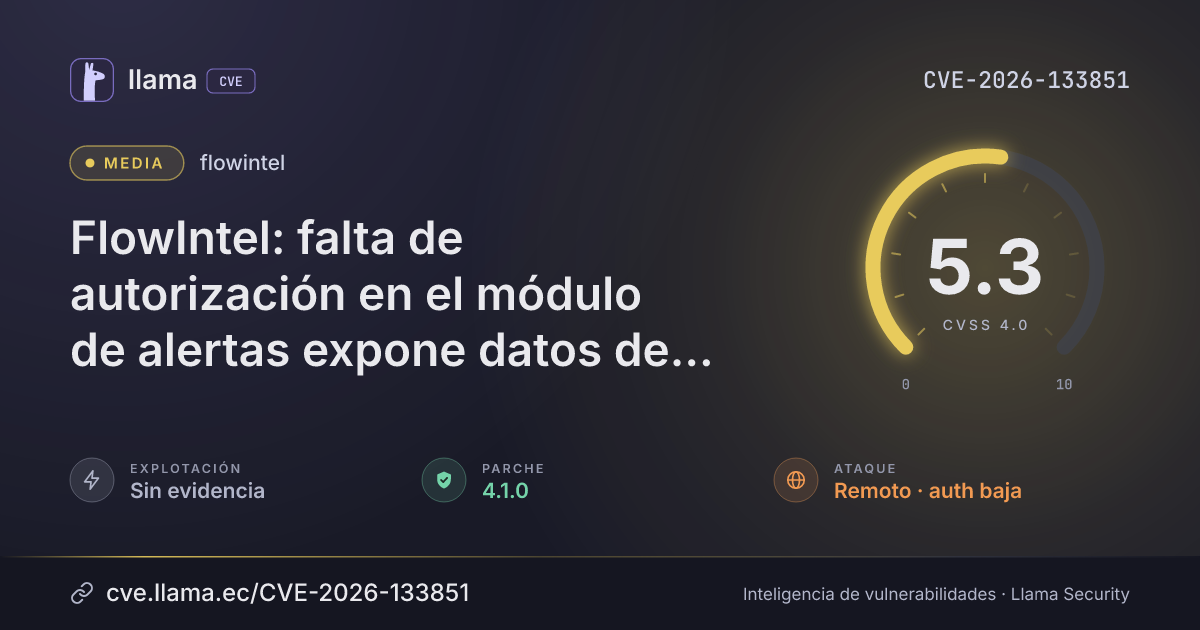
CVE-2026-133851
flowintel missing authorization in alerting exposes private case data
A low-privilege connector owner can keep reading revoked private case data and change alert status.
CVSS:4.0/AV:N/AC:L/AT:N/PR:L/UI:N/VC:L/VI:L/VA:N/SC:N/SI:N/SA:N
Fuente: CNA
Ciclo de vida de la vulnerabilidad
| Fecha | Fase | Evento | Detalle |
|---|---|---|---|
| Divulgación | Publicada | CVE-2026-133851 divulgada · CVSS 5.3 (CNA) | |
| Monitoreo | Detectada | Ingresó al índice | |
| Monitoreo | Fuente: NIST NVD | Registro visto por primera vez en NIST NVD | |
| Divulgación | Evaluación SSVC | CISA-ADP · explotación ninguna | |
| Divulgación | Modificada | Última actualización del registro | |
| Monitoreo | Fuente: ENISA EUVD | Registro visto por primera vez en ENISA EUVD | |
| Monitoreo | Verificada | Última verificación contra las fuentes |
FlowIntel's alerting module lets a remote attacker with a low-privilege login who is a connector owner keep reading private case data and change alert review status or create cases from alerts, even after their access to the linked private case was revoked or never existed. The flaw can also leak a competing case identifier to an unauthorized user during concurrent case-creation races.
Descripción original del registro (CIRCL)
FlowIntel's alerting module contained an authorization bypass in the alert access control logic. When an alert was linked to a private case, the system relied solely on connector ownership (user or organization) to determine access, without verifying that the requesting user still held valid membership in the associated private case. This meant that a user who was a connector owner of an alert could continue to read alert details, review history, raw payloads, and action comments, and could perform review-status updates or case-creation actions, even after their access to the linked private case had been revoked or they were never a member of that case. Additionally, a time-of-check to time-of-use (TOCTOU) gap existed: after a review-status update or a competing case-creation claim was committed, the response could disclose private case identifiers or review history to a user whose access had been concurrently removed by another session linking the alert to a private case. Impact: - Unauthorized disclosure of private case data (review comments, raw payloads, action history) through alert endpoints. - Unauthorized modification of alert review status and creation of cases from alerts the user should no longer access. - Leakage of a competing case identifier to an unauthorized user during concurrent case-creation races. Affected versions: FlowIntel prior to 4.1.0.
Desglose de métricas
Rangos afectados
Estado del parche por paquete
| Paquete / producto | Estado | Corregida en | Desde divulgación | Última versión |
|---|---|---|---|---|
flowintel |
Corregida | 4.1.0 | — | — |
4.1.0Arsenal público
Sin exploits, módulos ni PoC públicos conocidos a la fecha de verificación.
https://github.com/flowintel/flowintel/commit/68d85c78e464f023f9f77af9af39634d3b811fffLas referencias externas se muestran para copiar: cve.llama.ec no lo redirige a otros sitios.