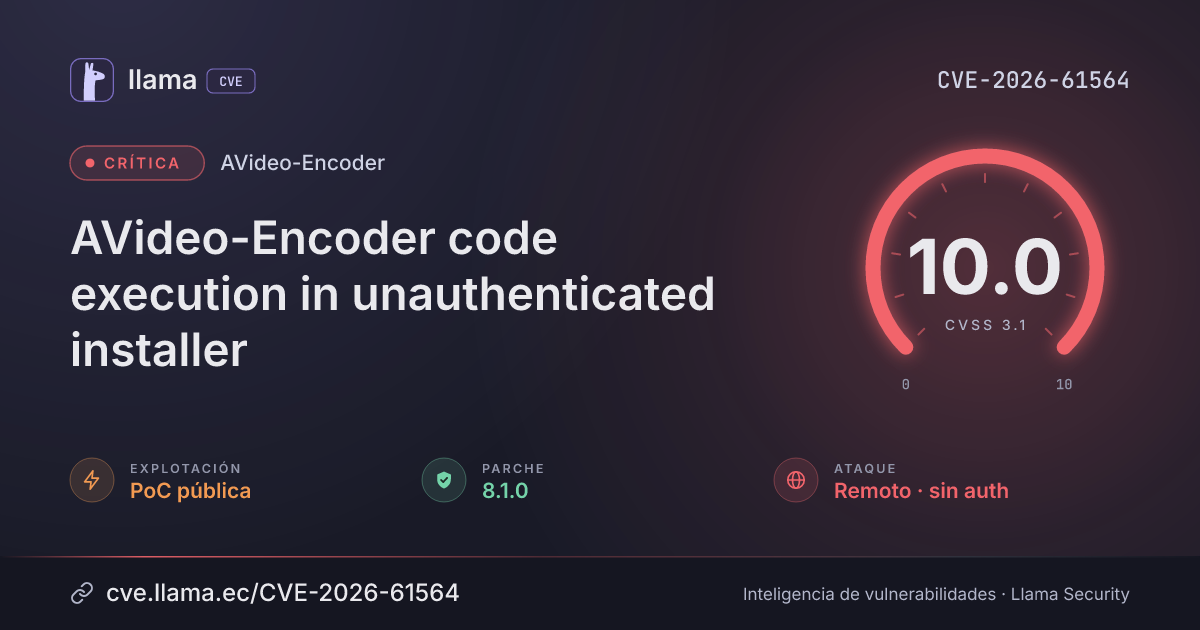
CVE-2026-61564
AVideo-Encoder code execution in unauthenticated installer
Attackers can inject PHP code into an unconfigured site's config file and run commands as the web server user.
CVSS:3.1/AV:N/AC:L/PR:N/UI:N/S:C/C:H/I:H/A:H
Fuente: CNA
Ciclo de vida de la vulnerabilidad
| Fecha | Fase | Evento | Detalle |
|---|---|---|---|
| Divulgación | Publicada | CVE-2026-61564 divulgada · CVSS 10 (CNA) | |
| Monitoreo | Detectada | Ingresó al índice | |
| Monitoreo | Fuente: NIST NVD | Registro visto por primera vez en NIST NVD | |
| Monitoreo | Fuente: ENISA EUVD | Registro visto por primera vez en ENISA EUVD | |
| Monitoreo | Fuente: OSV | Registro visto por primera vez en OSV | |
| Divulgación | Evaluación SSVC | CISA-ADP · explotación PoC pública | |
| Divulgación | Modificada | Última actualización del registro | |
| Monitoreo | Verificada | Última verificación contra las fuentes |
AVideo, an open-source video-sharing platform, is affected through its unauthenticated installer script, which lets an outside attacker inject PHP code into the site's configuration file on a fresh or unconfigured deployment. Successful exploitation could allow arbitrary command execution as the web-server user, along with reading, overwriting, or planting files and tampering with stored database settings.
Affects AVideo-Encoder before 8.1.0 on fresh installs where videos/configuration.php is absent, since the installer stays reachable. Fixed in 8.1.0.
Descripción original del registro (GitHub_M)
AVideo is a video-sharing Platform. Prior to 8.1.0, the unauthenticated installer endpoint `install/checkConfiguration.php` assembles `videos/configuration.php` by interpolating request parameters, including `webSiteRootURL`, into single-quoted PHP string literals without escaping. An attacker can terminate a literal and inject PHP that executes as the web-server user when the generated, directly requestable file is loaded. Exploitation requires `videos/configuration.php` to be absent, as on every fresh deployment or after the file is removed or moved; an existing file blocks this endpoint. The supplied `systemRootPath` must contain index.php and a connection using `databaseHost`, `databaseUser`, and `databasePass` must succeed, but the attacker can point those parameters to their own database server and needs no target credentials. The write location is also derived from `systemRootPath` without a base-directory constraint. This permits arbitrary command execution, reading and overwriting files owned by the web-server user, persistent PHP code, and control over stored database connection settings. The endpoint additionally interpolates request values into streamer and configuration INSERT statements, creating a secondary SQL-injection sink. This issue is fixed in version 8.1.0.
Condiciones y alcance
Desglose de métricas
Rangos afectados
Estado del parche por paquete
| Paquete / producto | Estado | Corregida en | Desde divulgación | Última versión |
|---|---|---|---|---|
AVideo-Encoder |
Corregida | 8.1.0 | — | — |
8.1.0Arsenal público
Sin exploits, módulos ni PoC públicos conocidos a la fecha de verificación.
https://github.com/WWBN/AVideo-Encoder/security/advisories/GHSA-xrj3-cqm8-r992https://github.com/WWBN/AVideo-Encoder/commit/0faaddebd11c087885d25a7e0513745465cad411https://github.com/WWBN/AVideo-Encoder/releases/tag/v8.1.0Las referencias externas se muestran para copiar: cve.llama.ec no lo redirige a otros sitios.